 ]]>
]]>Here’s my ‘top 10’ overview of the work:
You can read it here: https://nickfalvo.ca/non-market-housing-101/
]]>A ‘top 10’ overview of the presentation can be found here:
The episode is 31 minutes long and is available here:
https://www.youtube.com/watch?v=r3j_Y1jAW-E
Here’s the link to the post:
Thursday May 28, 9:30am – 4:30pm
Simon Fraser University Downtown Campus
(515 West Hastings Street, Vancouver)
Free Registration! …and even a Free Lunch! (Something Neoclassical Economists Say is Impossible)
Advance Registration Necessary:
Please send name, email & institution to info@centreforfuturework.ca
Topics & Instructors include:
DT Cochrane, Senior Economist, Canadian Labour Congress (Productivity: Measurement, Myth, and Reality)
Ian Hudson, Dept. of Economics, University of Manitoba (Work and Well-Being: How Unions and Labour Laws Translate Economic Growth into Human Progress)
Iglika Ivanova, Senior Economist and Co-Executive Director, B.C. Policy Solutions (Inequality: How to Measure It, Why It Matters, and What to do About It)
Mohsen Javdani, School of Public Policy, Simon Fraser University (Where Does Money Come From? Public Spending, Deficits, and the Documentary Finding the Money)
Marc Lee, Senior Economist, Canadian Centre for Policy Alternatives (International and Internal Trade: The Theory and Flawed Practice)
Jim Stanford, Economist and Director, Centre for Future Work (Corporate Financial Statistics: Accessing and Understanding Corporate Financial Statements)
Room location and detailed agenda will be distributed to registered participants.
]]>More info is available here: https://nickfalvo.ca/study-tours-2/
]]>It’s often claimed that this approach literally saves money. But is that claim valid?
I break it down here: https://nickfalvo.ca/does-housing-first-literally-save-money/
]]>Heterodox economics: the SSHRC, JEL and Australian classifications
by Marc Lavoie, Professor Emeritus, University of Ottawa
There sometimes is some confusion about the links between heterodox economics, history of economic thought, and even economic history, and their links with economics at large, and in particular with orthodox economics, neoclassical economics or the mainstream, however you want to name it.
Economists who publish in academic journals are aware of the classification provided by the American Economics Association, and more specifically by the Journal of Economic Literature (JEL), since they are usually required to provide the JEL codes that correspond to the topics of their journal submissions.
Some countries also provide nomenclatures to assess the importance of various research fields, often measured by the amount of research funds obtained in each of these research fields, despite the fact that some research fields do not necessarily require huge some sums of money to acquire new knowledge or useful information.
In Canada there is such a nomenclature of fields of research (https://www.statcan.gc.ca/en/subjects/standard/crdc/2020v1/introduction#_Overview), the Canadian Research and Development Classification (CRDC), found on a website of Statistics Canada and developed by the various federal research granting agencies, including the SSHRC. It is said that the CRDC, besides the recommendations of the OECD, is also inspired by the Australian and New Zealand Standard Research Classification (ANZSRC).
Economics (RDF5020) is one of five classes within a broader ‘Economics and Business Administration” group, which itself is within a “Social Sciences” division (https://www23.statcan.gc.ca/imdb/p3VD.pl?Function=getVD&TVD=1278187). Within Economics there are 28 subclasses or fields (https://www23.statcan.gc.ca/imdb/p3VD.pl?Function=getVD&TVD=1278187&CVD=1278241&CPV=RDF50201&CST=01012020&CLV=2&MLV=4). One of these 28 fields is called Economic History and Heterodox Economics (RDF5020101):
A first reaction is that combining Economic History and Heterodox Economics is rather awkward. In addition, it seems that History of Economics, or History of Economic Thought (HET), is associated with Economic History. Obviously, these two subjects are quite different. Also, although it is true that in the past (but probably not as much today) HET was conducted by scholars having some sympathy for non-mainstream approaches, the combination of HET and heterodox economics does not seem appropriate either, because it would imply that Heterodox Economics would be relegated to the study of past history and past theories! Thus, one would think that it would be best to have three separate streams: HET; Economic History; Heterodox Economics.
Indeed, this is what one can find in the Australian and New Zealand nomenclature. Its 2020 version for Economics is the same as the 2008 one, which was heavily discussed in Australia because of a 2007 attempt by the Australian Bureau of Statistics to move HET and Economic History to a new “History, Archaeology, Religion and Philosophy” research class. The proposal was eventually abandoned, as it was pointed out that the large majority of scholars working in economic history and the history of economic thought considered themselves to be economists first and foremost and held positions in Economics departments. Here is how the various classes and fields are set up in Australia and New Zealand:
| 38. ECONOMICS | ||||
| 3801 | Applied economics | |||
| 3802 | Econometrics | |||
| 3803 | Economic theory | |||
| 3899 | Other economics | |||
| 3801. Applied economics | ||||
| 380101 | Agricultural economics | |||
| 380102 | Behavioural economics | |||
| 380103 | Economic history | |||
| 380104 | Economics of education | |||
| 380105 | Environment and resource economics | |||
| 380106 | Experimental economics | |||
| 380107 | Financial economics | |||
| 380108 | Health economics | |||
| 380109 | Industry economics and industrial organisation | |||
| 380110 | International economics | |||
| 380111 | Labour economics | |||
| 380112 | Macroeconomics (incl. monetary and fiscal theory) | |||
| 380113 | Public economics – public choice | |||
| 380114 | Public economics – publicly provided goods | |||
| 380115 | Public economics – taxation and revenue | |||
| 380116 | Tourism economics | |||
| 380117 | Transport economics | |||
| 380118 | Urban and regional economics | |||
| 380119 | Welfare economics | |||
| 380199 | Applied economics not elsewhere classified | |||
| 3803. Economic theory | |
| 380301 | History of economic thought |
| 380302 | Macroeconomic theory |
| 380303 | Mathematical economics |
| 380304 | Microeconomic theory |
| 380399 | Economic theory not elsewhere classified |
| 3899. Other economics | |
| 389901 | Comparative economic systems |
| 389902 | Ecological economics |
| 389903 | Heterodox economics |
| 389999 | Other economics not elsewhere classified |
Economic History, History of Economic Thought and Heterodox Economics are clearly separated. Economic History belongs to the field of Applied Economics; History of Economic Thought belongs to Economic Theory; and Heterodox Economics, is within Other Economics, along with Ecological Economics, which today has several links with heterodox economics in general and post-Keynesian economics in particular. It would be nice if Canada could adopt a similar setup for these three fields.
What about the classification provided by the Journal of Economic Literature (JEL)? Its classification contains 20 key codes, one of which is a code entirely devoted to Economic History (code N), with multiple subcodes. Many N subcodes are devoted to the economic relations between Canada and the USA. It is true that there are historians who successfully deal with economic topics, a name that comes to mind today is Adam Tooze, at Columbia University, but Tooze was trained at Cambridge (UK) at a time when historians had to take seminars in economics.
With respect to Heterodox Economics, the JEL classification is a bit messy. It has a B code, called History of Economic Thought (B1-B3), Methodology (B4) and Heterodox Economics (B5). The JEL classification says that: “The categories for B5 were created to accommodate the recent substantial developments in non-mainstream (non-neoclassical) economic approaches to contemporary economic problems. Studies about an economic subject (or subjects) adopting a given heterodox approach should be cross-classified under the appropriate B5 category and also under the appropriate subject category (or categories)”. This is confirmed by the fact that several heterodox schools also appear in the E category (Macroeconomics and Monetary Economics), more specifically in the E1 code (Aggregative models), along with Neoclassical economics (the mainstream):
| E11 | Marxian • Sraffian • Kaleckian |
| E12 | Keynes • Keynesian • Post-Keynesian • Modern Monetary Theory |
| E13 | Neoclassical |
| E14 | Austrian • Evolutionary • Institutional |
Modern Monetary Theory (in my view a branch of Post-Keynesian Economics) also appears in E6 (Macroeconomic Policy, Macroeconomic Aspects of Public Finance, and General Outlook), within E62 (Fiscal policy)!
As claimed earlier, despite its detailed coding, or perhaps because of it, the JEL classification is somewhat confusing. For instance, post-Keynesian economics and Kaleckian economics, which appear in code E11 and E12 are not found among the heterodox schools listed in B5.
| B5. Current Heterodox Approaches | |
| B50 | General |
| B51 | Socialist • Marxian • Sraffian |
| B52 | Historical • Institutional • Evolutionary • Modern Monetary Theory |
| B53 | Austrian |
| B54 | Feminist Economics |
| B55 | Social Economics |
Coming back to the Canadian nomenclature, one would think that Heterodox Economics, History of Economic Thought and Economic History are three different subjects that ought to belong to the Economics research class. Economic History has clearly no or very little relationship with the other two fields. Putting together Heterodox Economics and History of Economic Thought would be an improvement over the current Canadian classification, but could only be a second-best solution, since it would give the impression that Heterodox Economics only deals with verbal discussions of past ideas and theories, whereas numerous scholars linked to Heterodox Economics use algebraic modeling and empirical analysis, including econometrics, and are involved in economic policy analysis. The Australian and New Zealand classification looks like the most appropriate one with regards to the three fields being considered in this note. A new Canadian classification is planned to be announced by Statistics Canada sometime in June.
]]>A ‘top 10’ summary of the new chapter can be found here: https://nickfalvo.ca/homelessness-among-2slgbtqia-individuals/
All material related to the book can be found here (free of charge): https://nickfalvo.ca/book/
]]>People can watch or listen to the episode here:
]]>Here’s the link (it’s 40 min’s long): https://thepublicationcoop.substack.com/p/canadas-so-called-homelessness-strategy
]]>Here’s a ‘top 10’ overview: https://nickfalvo.ca/affordable-housing-and-homelessness-in-helsinki-finland/
]]>Here are 10 things know:
Here’s a ‘top 10 overview of the study tour:
https://nickfalvo.ca/homelessness-and-supportive-housing-in-alberta/
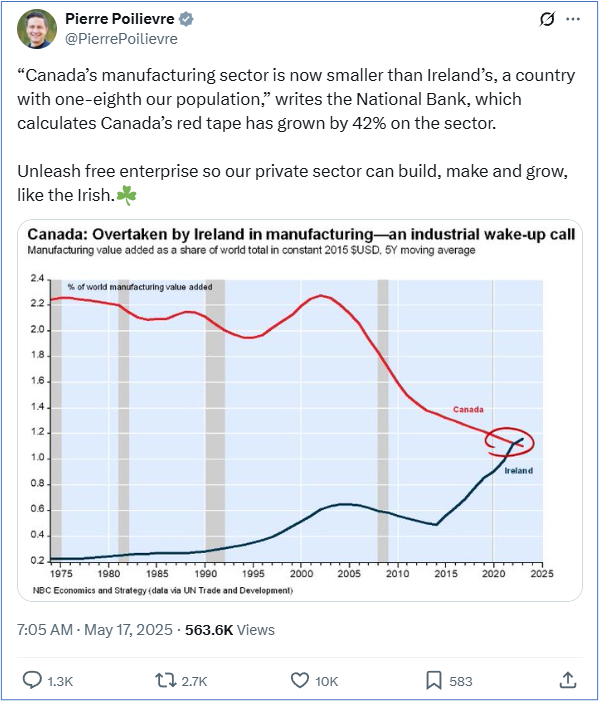
Poilievre’s post was based on a one-page blog commentary from researchers at the National Bank, who claimed this shocking outcome is an “industrial wake-up call” for Canada to reduce regulation and cut energy prices.
The claim that Canada’s manufacturing sector is smaller than Ireland’s is false, and constitutes another clear misuse of comparative GDP statistics between Ireland and other industrial countries. Similar manipulations involve comparisons of other indicators like per capita GDP or productivity between Ireland and other industrial countries. I recently explored the problems of per capita GDP comparisons to Ireland in a commentary for Policy Options.
Ireland is a tax haven. It has the lowest corporate tax rate in the EU. This has incented major multinational corporations (like Apple, Microsoft, and Pfizer) to establish subsidiaries there. By using internal transfer pricing and other artificial arrangements to shift bottom-line profits to Ireland, they avoid paying higher tax rates in other countries. This is good for those companies, but undermines government fiscal capacity in all countries.
This practice also artificially boosts Ireland’s reported GDP, since profits of an Irish-based subsidiary count as domestic value-added. (They are not counted in gross national product, which measures the value-added owned by Irish people; GNP is about one-third lower than GDP in Ireland’s case, an unusually large gap between the two measures that reflects the distorting effect of MNC profits there.) Foreign-dominated sectors make up about 45% of Ireland’s GDP, and most of that consists of corporate profit—very little of which is ever touched by Irish people.
This artificial inflation of Irish GDP statistics is especially severe in Ireland’s manufacturing sector, since most of those multinational firms using Ireland as a ta-avoiding base of operations are defined as manufacturers (mostly in computers, other technology, and pharmaceuticals). Compared to inflated value-added statistics, surprisingly little of their tangible industrial output is actually produced in Ireland.
According to Irish statistics, about 75% of manufacturing value-added is concentrated in computer and electronic equipment and pharmaceuticals. The large majority of that value-added reflects profits captured by overseas multinationals, with little relationship to the output, incomes, or well-being of Irish people.
This tax avoidance badly distorts statistics on economic activity of various sectors in Ireland. Manufacturing accounts for 31% of Irish GDP, but only about 10% of employment—much of which is employment in the offices of those Irish subsidiaries (as opposed to people actually making stuff). Yes, manufacturing has higher average productivity—but that cannot explain a 3-to-1 difference between the GDP share and the employment share.
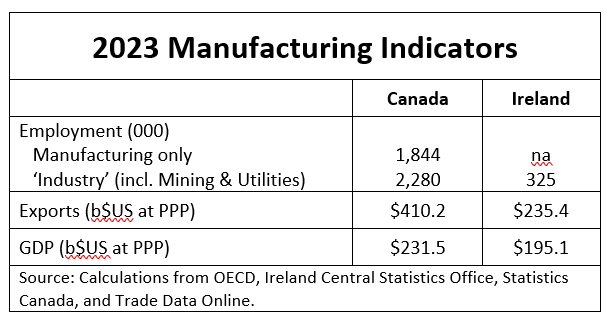
Ireland’s labour market data reports employment for a broad category called ‘Industry’ (which includes manufacturing, mining, and utilities). That broad sector employed 325,000 people in 2023. In Canada, manufacturing proper employed over 1.8 million people that year. Including mining and utilities (to be comparable to Ireland’s ‘Industry’ category), Canada employed close to 2.3 million people. Canada’s manufacturing sector thus employs 6 to 7 times as many people as Ireland’s. It is ridiculous to claim that Ireland’s manufacturing sector is ‘bigger’ in any material sense.
Another measure less sensitive to the distorting effects of Ireland’s GDP statistics is exports, which measure flows of actual merchandise (rather than paper transactions). Ireland exported about 180 billion euros worth of manufactures (broadly defined to include crude materials and fuels) in 2023. That is about $235 billion (U.S.) at the OECCD’s purchasing power parity exchange rate for that year. Canada exported $465 billion worth of (more narrowly defined) manufactures that same year, or $410 billion in $U.S. dollar terms (at the PPP exchange rate). That is 75% more than Ireland. And since Canada is much larger than Ireland (by both geography and population), exports constitute a smaller share of total manufacturing output here. Hence the ratio of physical manufacturing output will be higher still for Canada—almost certainly twice as large.
Even by GDP comparisons, distorted by the paper-profit-shifting problem discussed above, Canada’s manufacturing output is about 20% higher than Ireland’s (compared at PPP exchange rates). Keeping in mind that over half of Ireland’s supposed manufacturing value-added reflects the artificial profits of multinational firms, it is clear that by any measure Canada’s manufacturing activity is much larger than Ireland’s.
The claim by both Mr. Poilievre and the National Bank that Canada’s manufacturing sector has suffered a catastrophic decline is also false. The National Bank chart reposted by Mr. Poilievre describes a very unusual metric: it shows each country’s share of world manufacturing GDP, valued in 2015 constant-dollar terms, converted to $US at the 2015 exchange rate, and then transformed again to a 5-year moving average. In addition to the fundamental problem of accurately measuring Irish GDP, therefore, this metric embodies four additional transformations of the data—each of which creates opportunity for misunderstanding or even manipulation:
On this latter point, consider that official Irish data indicate that real manufacturing GDP collapsed by 23% in 2023. Why? Because most of that supposed GDP consists of the profits of multinational firms, which reached all-time highs in 2022 (thanks to profit-led inflation following the COVID pandemic). As supply chains normalized, profits around the world fell in 2023. In Ireland’s case, that caused a sharp decline in apparent GDP—but with little impact on actual work and output.
Honestly portraying this extreme volatility of Irish manufacturing GDP would raise immediate suspicions about what these statistics actually portray. How could a supposed industrial success story be prone to such extreme roller-coasters of activity? And how could industry contract 23% in one year without widespread hardship and factory closures? This bizarre feature of Ireland’s GDP statistics is hidden, however, by the arbitrary use of a five-year average. That 23% decline in output in 2023 (the last year of the National Bank chart) would have left Ireland’s line—even with its misleading conception of GDP—well below Canada’s. That would have spoiled a great sound bite (and no doubt mitigated against the chart’s use as a Conservative talking point).
The National Bank’s CEO, Laurent Ferreira, is celebrated in conservative media and political circles for his strong critiques of Canada’s “excessive regulation and oversight”, and for opposing an emissions cap on the petroleum industry. The National Bank’s strangely convoluted and misleading blog post is fully aligned with Ferreira’s perspective, even down to stressing the importance of deregulation and expanded energy supply for future manufacturing success. The vigour with which this research was taken up by the Conservatives’ communications team further indicates close alignment with right-wing talking points.
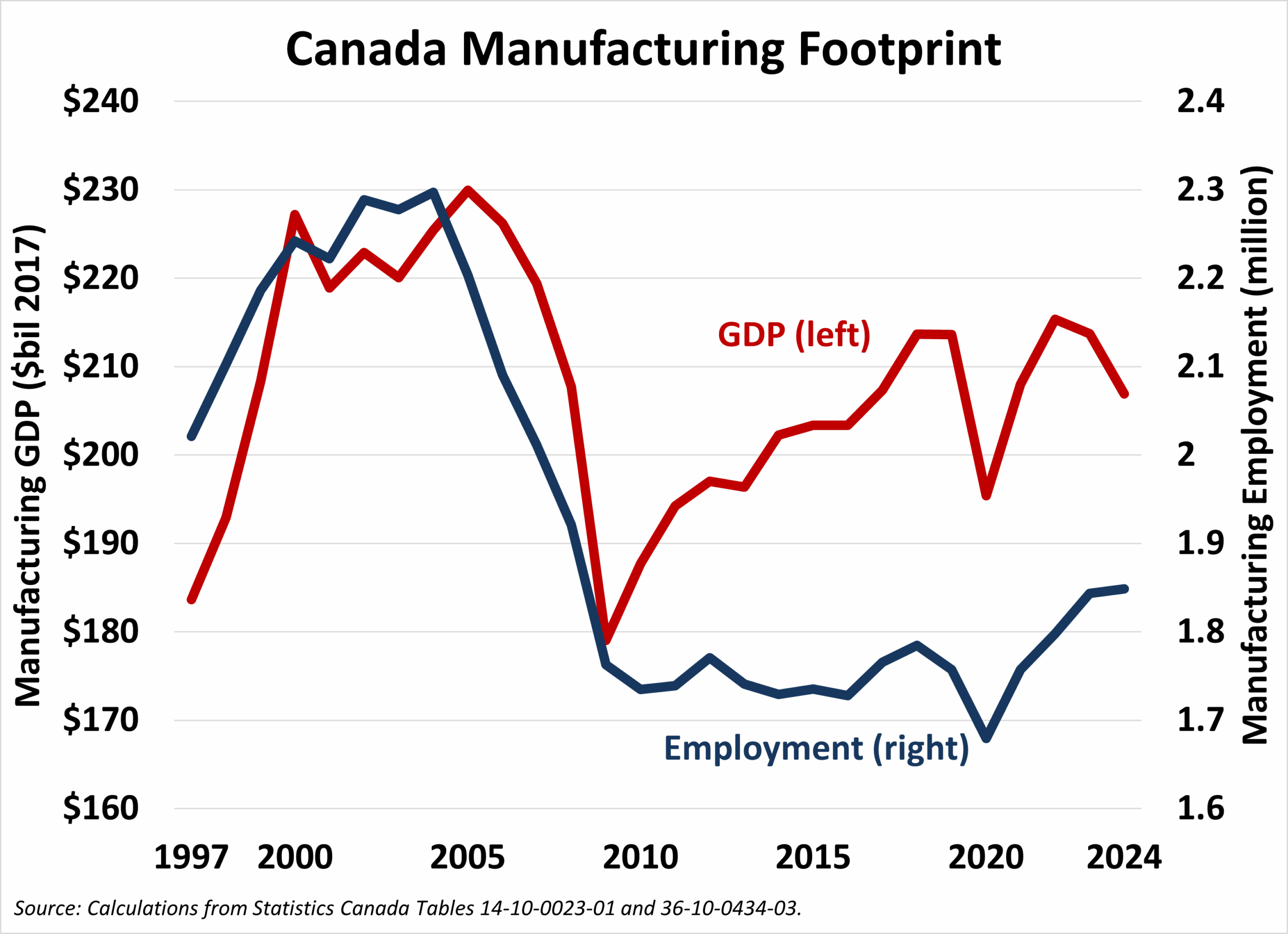
The post’s claim that the “profound atrophy of Canada’s manufacturing base [is] unmatched across the industrialized world” is not remotely true. Yes, manufacturing in Canada has experienced many challenges since the turn of the century. The sector experienced a sharp decline in both GDP and employment from 2005 through 2010 (most of which occurred under the Conservative government of Stephen Harper). This downturn reflected the negative spillovers of an overvalued currency (largely caused by rapid expansion of petroleum exports, which Mr. Ferreira wants more of) followed by the 2008-09 financial crisis (including a near-meltdown in the automotive industry).
However, the industry stabilized after 2010. It has since won back about two-thirds of the GDP lost during the latter 2000s. Employment has increased, but more modestly. (The fact that GDP has recovered faster than employment reflects productivity growth in manufacturing, which is also a good sign.)
In short, the hard data on Canadian manufacturing does not at all confirm to the “lost decade” narrative of Mr. Poilievre and his supporters. If anything, it shows manufacturing still recovering from a much earlier crisis in the late 2000s, when policy neglect and a dollar above par dealt a body blow to domestic industry. Canadian manufacturers are challenged, but resilient. This is a more genuine depiction of the state of Canadian manufacturing, than the convoluted National Bank chart, which deliberately conveys a false impression of continuous decline.
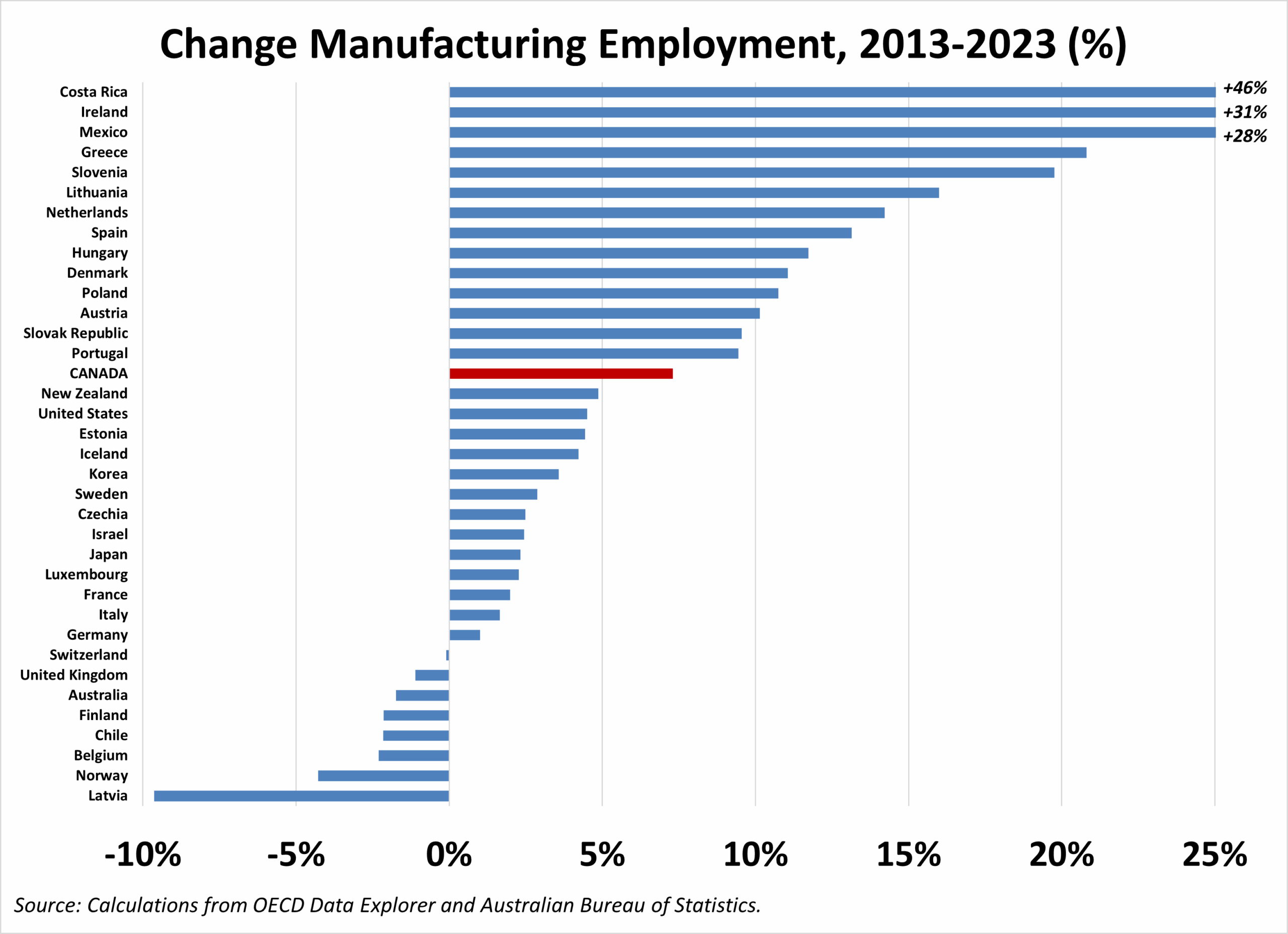
And in international terms, the claim Canada’s industrial decline is “unmatched” is an outright lie. Most industrial countries face similar challenges of deindustrialization, the rise of emerging exporters, energy transitions, and other factors. Canada ranks in the middle of the OECD pack. For example, according to OECD data, manufacturing employment in Canada grew 7.3% in the decade ending in 2023—slightly better than the OECD average, and better than the U.S.. We ranked 15th among 36 OECD countries reporting data by that score.
Yes, Ireland’s manufacturing employment grew very rapidly: by 31% over the same period (second only to Costa Rica in the OECD). If we had more detailed data (disaggregating production workers from office workers, for example), it would likely confirm that most of those jobs are not in factories, but in the offices of Irish subsidiaries of global firms (which are classified as manufacturers). Most of them are working on tax loopholes, not tangible products.
Conservative commentators have tried to use Ireland as a poster child for free market economics for years. Their empirical claims are flawed, and belie a deep misunderstanding of how Ireland’s economy works. Mimicking Ireland’s recipe, as Mr. Poilievre suggests, would involve trying to make Canada a tax haven. This wouldn’t work, even if we were convinced it was a good thing. There are good reason tax havens are always small countries, usually islands: to concentrate the lure of the tax incentive on mobile companies and investors, and then share the resulting largesse amongst a relatively small host population. Canada wouldn’t work as a tax haven, and most Canadians don’t want to try. Much better to work with other countries on international tax rules to limit the mis-use of policies like Ireland’s.
Ireland is not the richest country in the OECD on per capita grounds. It does not have the highest productivity growth of any country on earth. And it does not have a larger manufacturing industry than Canada. What it has is a tax regime that is immensely lucrative for global companies and the billionaires who run them—but that delivers scant benefit to most Irish people, and undermines fairness and economic efficiency everywhere else. Including Canada. Mr. Poilievre’s mis-use of this blatantly misleading factoid reveals both his pro-business biases, and his communications team’s failure to fact-check their economics.
]]>Given Trump’s proclivity to simply invent statistics on trade and other economic indicators, it is important that Canadians have the actual data in hand to evaluate the outcome of this historic meeting.
Here are updated indicators regarding the U.S. bilateral trade relationship with Canada and other countries. They update material contained in the Centre for Future Work’s report from January, Who’s Subsidizing Whom? See that original report for more information on measuring and understanding trade imbalances, and analysis of ways in which Canada subsidizes the U.S. through several unusually favourable trade arrangements.
The overall U.S. trade deficit in goods and services increased in 2024, reaching $918 billion. That’s an increase of 17% from 2023, but still below the all-time high nominal deficit of $944 billion recorded in 2022. As a share of U.S. GDP, the deficit equaled 3.1% in 2024, well below the 3.6% recorded in 2022 – and significantly lower than deficits incurred in earlier years (deficits were over 5% of U.S. GDP in the mid-2000s).
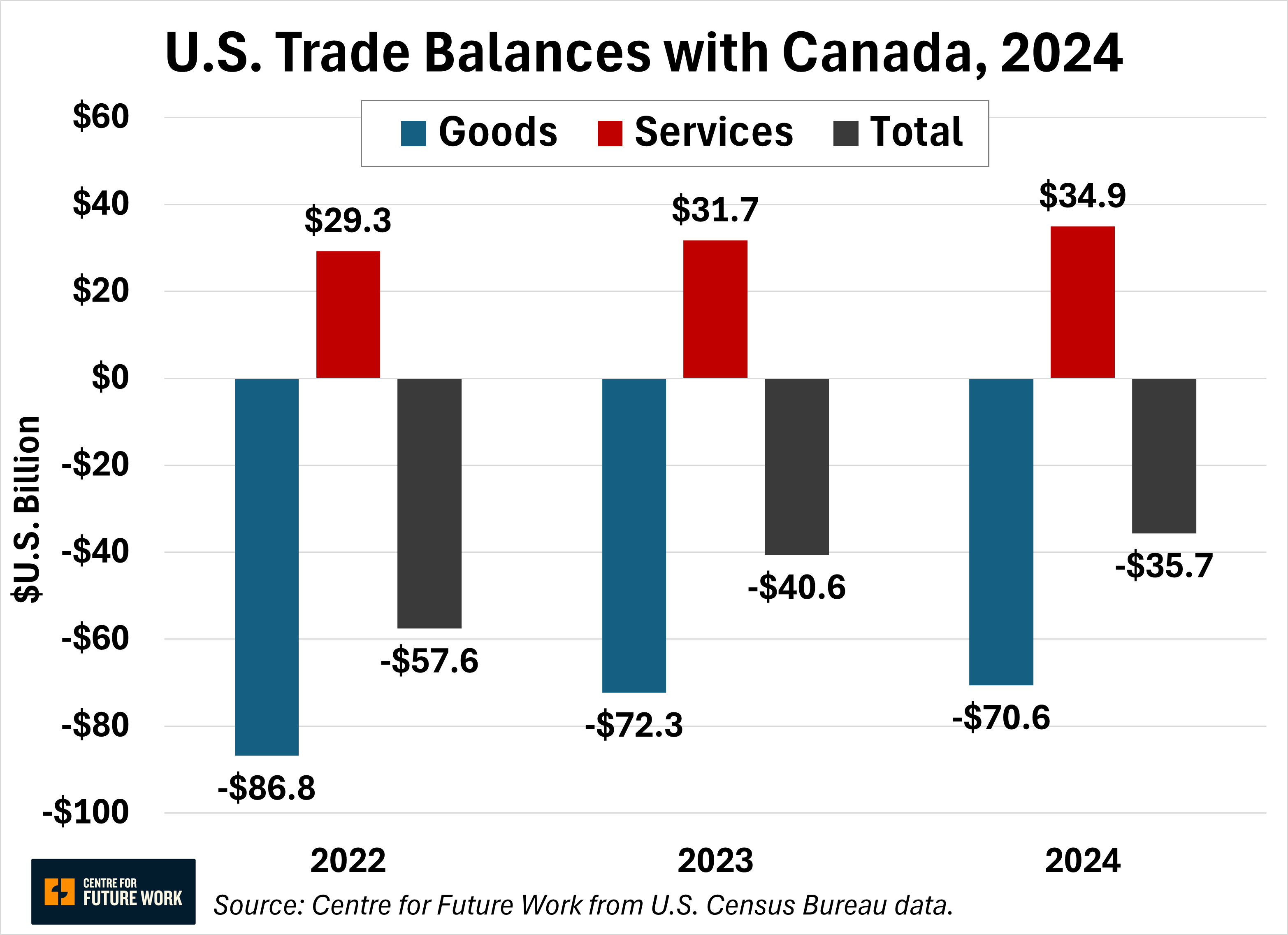
However, America’s trade with Canada bucked that trend in 2024. U.S. imports from Canada declined by $6 billion, while U.S. exports to Canada were steady. The bilateral U.S. deficit in goods and services with Canada thus shrank by 12%, falling to $35.7 billion (U.S.). The U.S. trade deficit with Canada in 2022 ($57.6 billion U.S.) was inflated by high prices for oil (Canada’s largest export to the U.S.). In just two years, therefore, the bilateral deficit with Canada has declined by almost 40%.
Trump has regularly claimed that the bilateral U.S. trade deficit with Canada amounts to hundreds of billions of dollars. That claim is false – as is his claim that this deficit amounts to a “subsidy.”
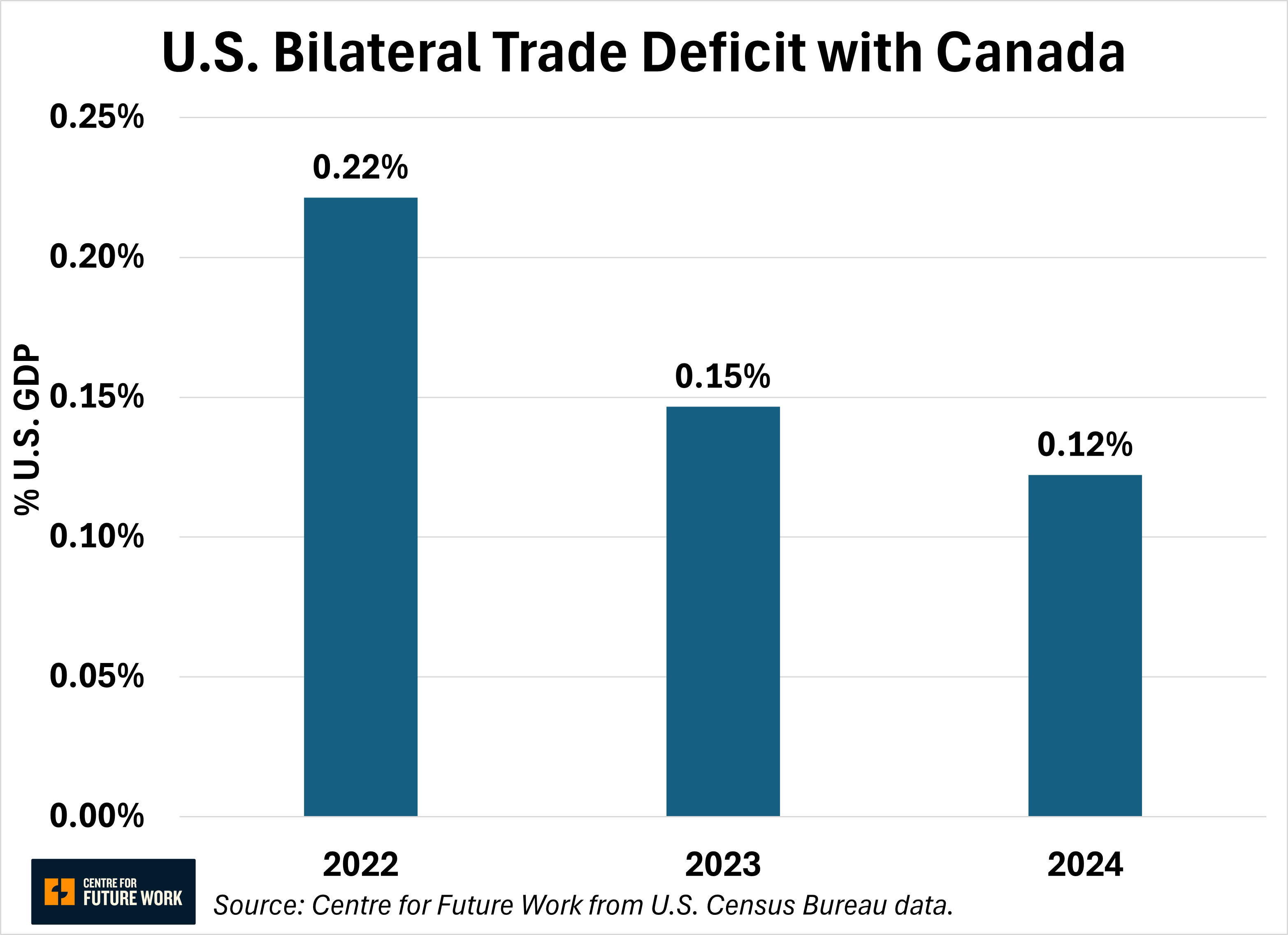
Relative to overall U.S. spending, the U.S. trade deficit with Canada equaled 0.12% of U.S. GDP in 2024. That is barely half the relative size of the bilateral deficit in 2022 (0.22%). The bilateral deficit with Canada equaled less than 4% of the U.S. global trade deficit in 2024.
It is interesting to compare the trajectory of bilateral trade in goods and services. America’s bilateral deficit in goods trade with Canada has shrunk significantly in the last two years (again, largely due to moderating oil prices). The U.S. bilateral surplus in services trade has grown steadily. The bilateral services surplus ($35 billion in 2024) now offsets half of the goods deficit.
Trump generally ignores services industries in launching his attacks on other countries – for the obvious reason that the U.S. has a large surplus in services trade (almost $300 billion in 2024), undercutting his argument that the U.S. is “taken advantage of” by the rest of the world. This week, however, he has imposed tariffs on the film industry (an important tradeable service), and may consider other services-related trade actions.
Given Canada’s disproportionate purchases of U.S. services, there is considerable scope to consider application of counter measures targeting U.S. services businesses (such as data, business, technology, and financial services). That would enhance Canada’s leverage in future trade negotiations with the U.S.

America’s bilateral deficit with Canada ranks tenth among U.S. trading partners, It is one-seventh the size of the U.S. deficit with China, and much smaller than deficits with Mexico and other Asian countries.
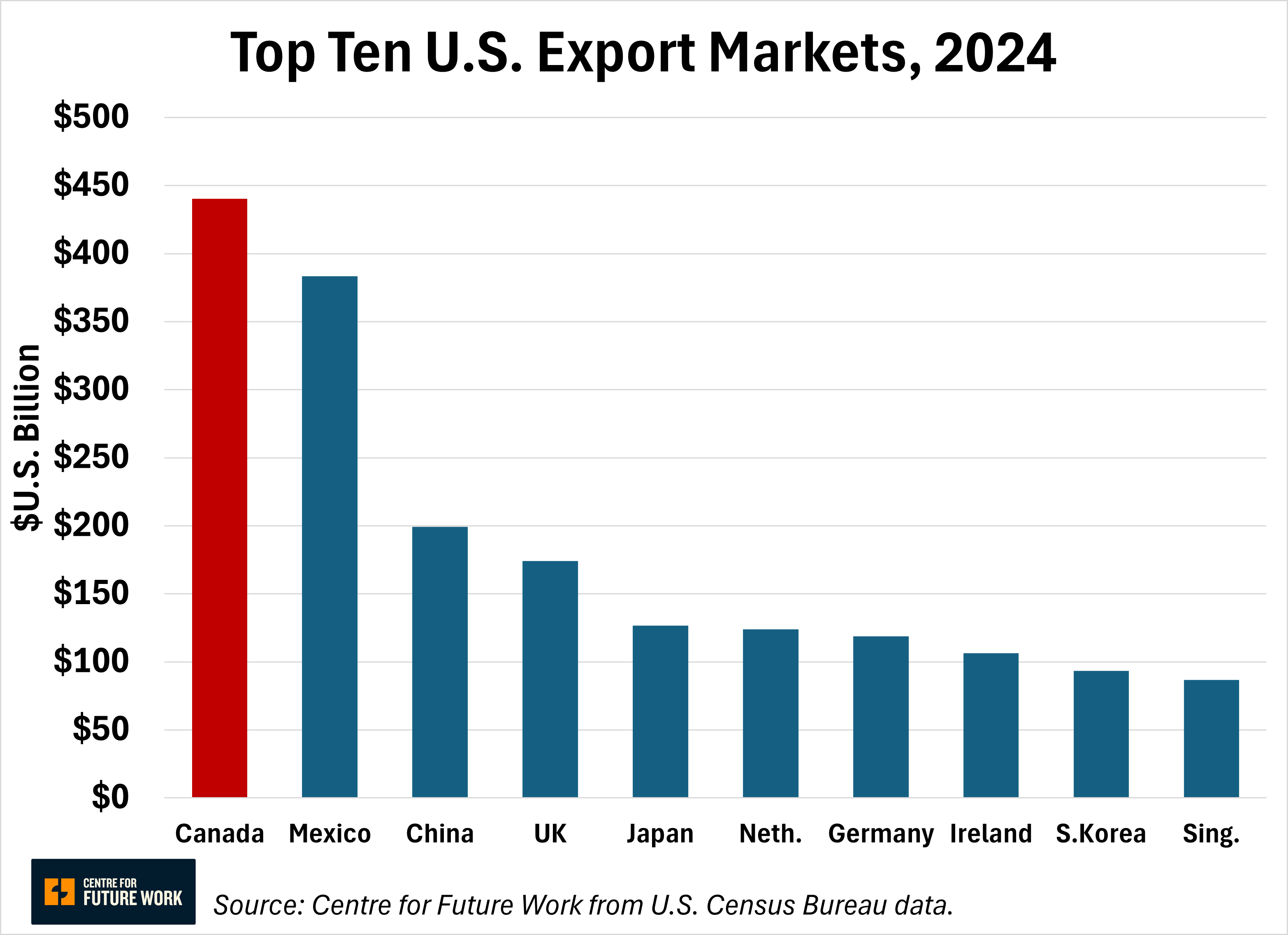
Canada retained its crown as the largest export market for U.S. goods and services in 2024. Canada purchased $440 billion in imports from the U.S. in 2024, equal to 14% of America’s worldwide export sales. Again, the importance of the Canadian market to U.S. businesses gives Canada significant bargaining leverage in future trade discussions. Canada purchased more than twice as much from the U.S. last year, as China did.
America’s small bilateral deficit with Canada pales further in comparison to the enormous two-way trade between the two countries: $916 billion in total in 2024, by far the largest bilateral trade flow between any two countries in the world. Canada purchased 92.5 cents of imports from the U.S., for every dollar of Canadian exports going to the U.S. And that bilateral trade flow has become gradually more balanced in recent years.
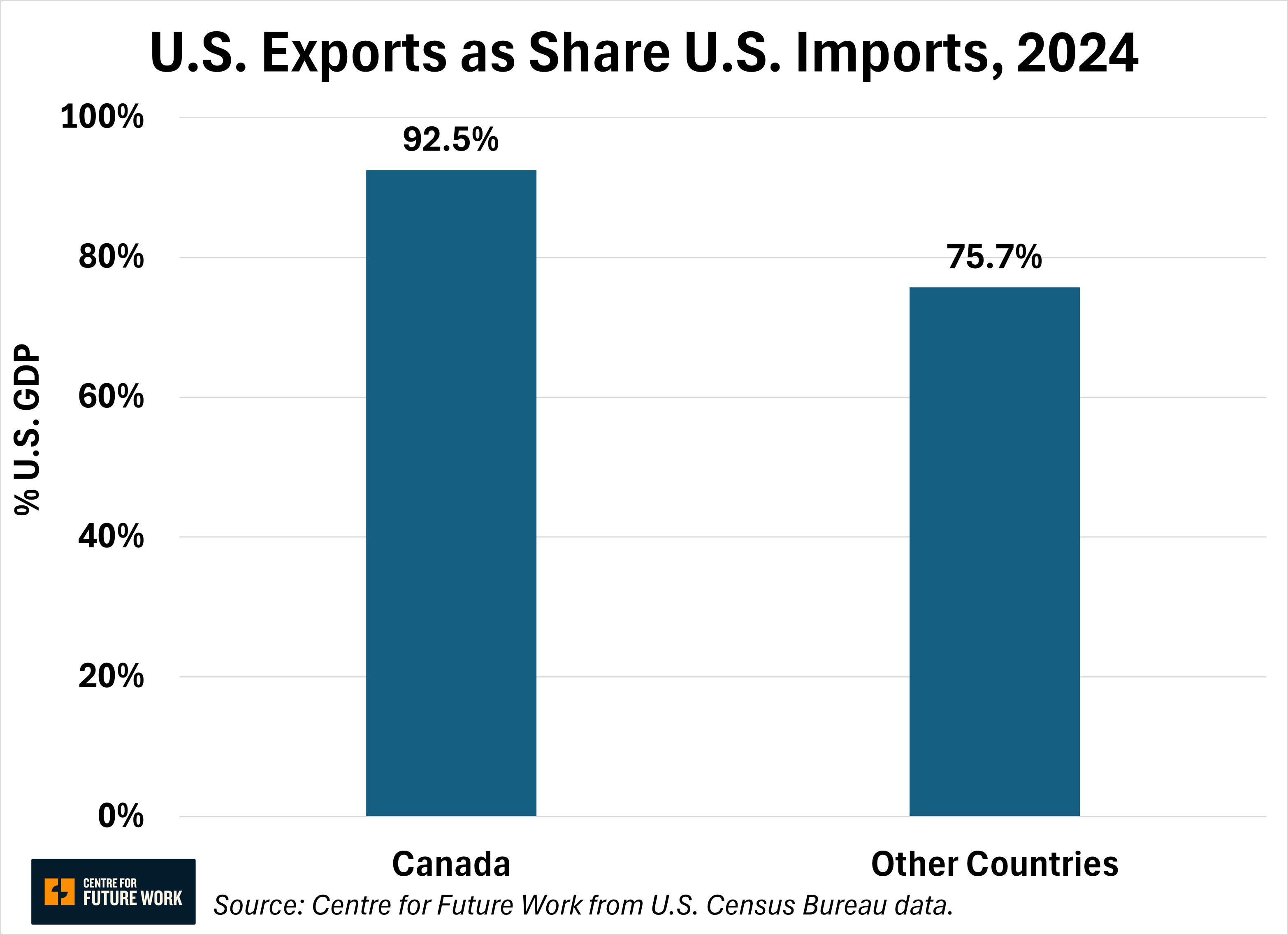
America’s trade with Canada is significantly more balanced than its trade with other countries. Excluding Canada, the U.S. exports just 75.7 cents for every dollar it imports. Curtailing trade with Canada would thus have the self-defeating effect of making America’s overall trade even less balanced.
Trump’s erratic and inconsistent trade announcements have made it clear that his actions are not motivated by a genuine concern with trade deficits – any more than they are motivated by issues such as fentanyl, defense spending, or agricultural supply management. But this latest official data from the U.S. government’s own statistical agency confirms that the U.S. trade deficit is not large by historic standards. And America’s bilateral trade with Canada is uniquely balanced and beneficial.
Please see the Centre for Future Work’s earlier report, Who’s Subsidizing Whom?, for more analysis of the bilateral Canada-U.S. trade relationship, the ways in which Canada subsidizes the U.S. through unusually lucrative trade arrangements, and options for Canadian negotiators in resisting Trump’s unfounded attacks.
]]>The workshop was titled “The intersection of housing and homelessness.”
All course material is now available here (free of charge):
https://nickfalvo.ca/courses/
Here’s my ‘top 7’ overview of the Liberal Housing Plan: https://nickfalvo.ca/the-liberal-housing-plan/.
]]>Here’s a link to the blog post that summarizes my remarks:
https://nickfalvo.ca/what-lies-ahead-for-community-level-homelessness-planning-in-alberta/
Incidentally, on that point the Centre for Future Work’s recent report, Counting the Costs: Impacts of the 2022 Oil Price Shock for Canadian Consumers and Workers, provides some badly-needed perspective on why affordability became such an issue after the pandemic. No, it wasn’t government spending too much on CERB benefits, or the Bank of Canada acting as Justin Trudeau’s ATM, or immigrants driving up housing costs. And no, it wasn’t even the carbon tax. The oil price spike of 2022, transmitted directly to Canadian consumers and supply chains, was by far the largest single cause of the acceleration of inflation that has bedeviled Canadians since (including via the Bank of Canada’s interest rate hikes). Most maddening is that there was no real supply-and-demand explanation for that oil prices spike; oil supply (globally and in Canada) continued growing throughout 2022, even through the Russian invasion of Ukraine. Financial speculation on futures markets, not a genuine supply shock, is the culprit.
Inflation has come back down to target, but price levels still seem high (that’s how it works: when inflation stops, the price level stops rising, but is still higher than it was before the inflation). Canadians’ anger at that should be directed at the true causes of the problem, not at phony ight-wing scapegoats (like taxes, deficits, climate policy, or work-from-home arrangements in the public sector).
Speaking of scapegoats, a lot of vitriol has been directed at supermarkets for the rise in food prices since the pandemic–and rightly so. There are many causes of higher food prices, of course–including the trickle-down impact of fossil fuel costs through the food supply chain (see Zoe Yunker’s excellent story in The Tyee on the “Counting the Costs” report for some discussion of that angle). But there is absolutely no doubt that food retailers, dominated by the major chains (the top 5 control 80% of food sales in Canada), took advantage of rising inflation, shortages, and consumer confusion to increase profits on the backs of Canadian shoppers.
Grocery chain CEOs and free-market economists scoff at the idea that supermarkets (or any corporations, for that matter) “caused” inflation with their higher prices and profits. Inflation can only be caused by too much money supply, or excess demand–not by corporations wielding their power to pro-actively set prices. Greed has always existed, of course. But the unique (and thankfully temporary) disruptions of the pandemic allowed greed to go to town. Particularly in industries occupying a strategic place in the macroeconomic supply chain, and/or selling essential goods which are purchased no matter their price, profits shot up unduly and unjustly. There is plenty of evidence globally and in Canada about the existence and consequences of profit-led inflation. In Canada profits surged to their highest share of GDP in history in 2022, alongside inflation. And as profits (in most industries, not all–see below) moderated, inflation returned to normal.
In his campaign, NDP Leader Jagmeet Singh is addressing the problem of food prices with a multi-part agenda to reduce food prices in Canada, including a compulsory Code of Conduct for grocers, stronger powers for the competition bureau, and a price cap on a modest basket of defined essential foodstuffs (to support low-income Canadians in keeping at least the basics on their tables). Predictably, his proposal has been debunked by those who deny that corporate behaviour had anything to do with post-pandemic inflation.
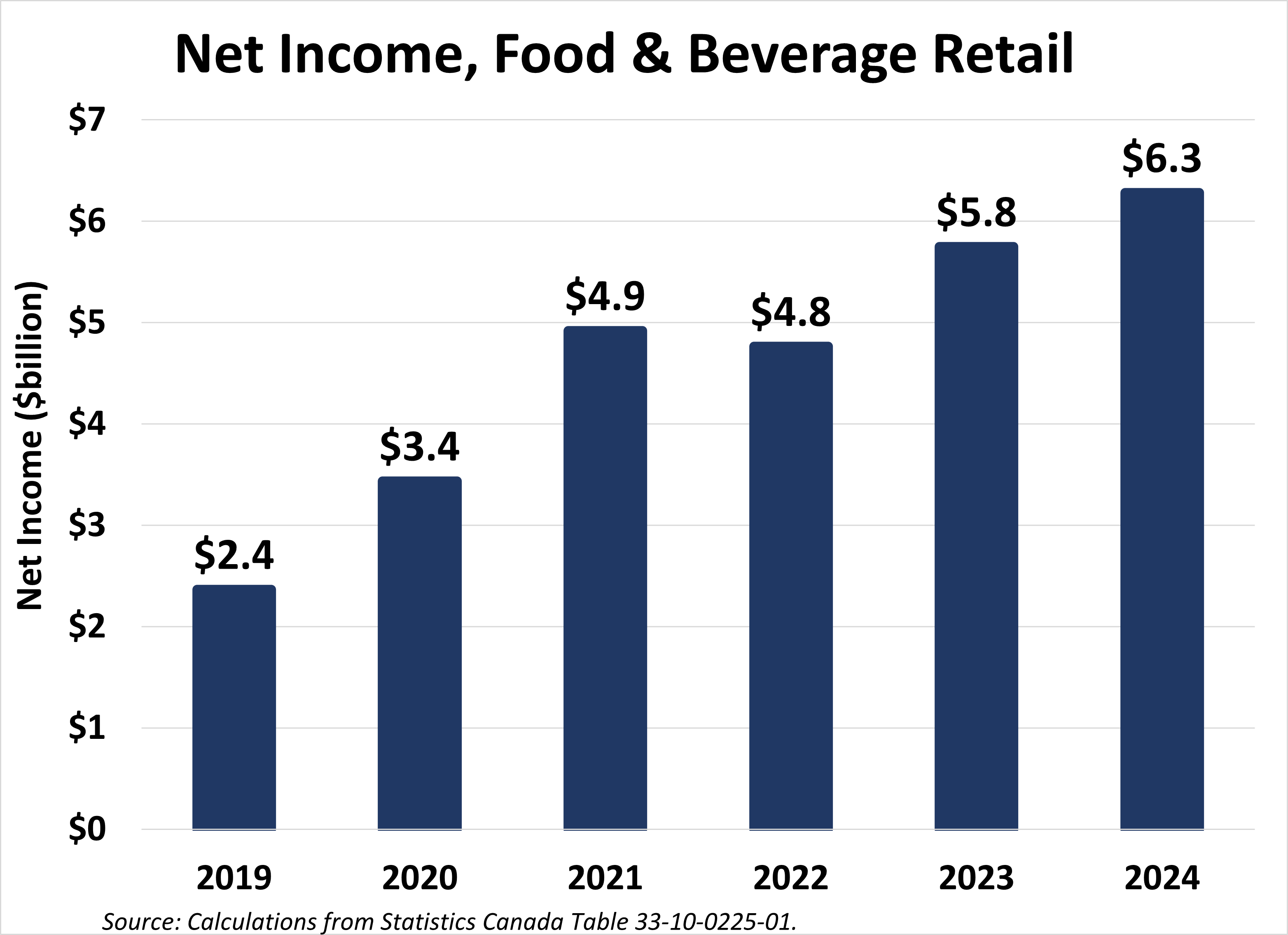
Let’s revisit the economic evidence about the role of profit-led inflation in the food price challenges facing Canada. Supermarkets were not just “passing on” higher costs for their inputs–they were substantially fattening their own take at the same time. After-tax net income in the food and beverage retail sector (two-thirds of which is captured by Loblaw, Metro, and Sobeys) more than doubled after 2019. In 2024 they reached an all-time high of $6.3 billion (compared to $2.4 billion in 2019, the last year before the pandemic).
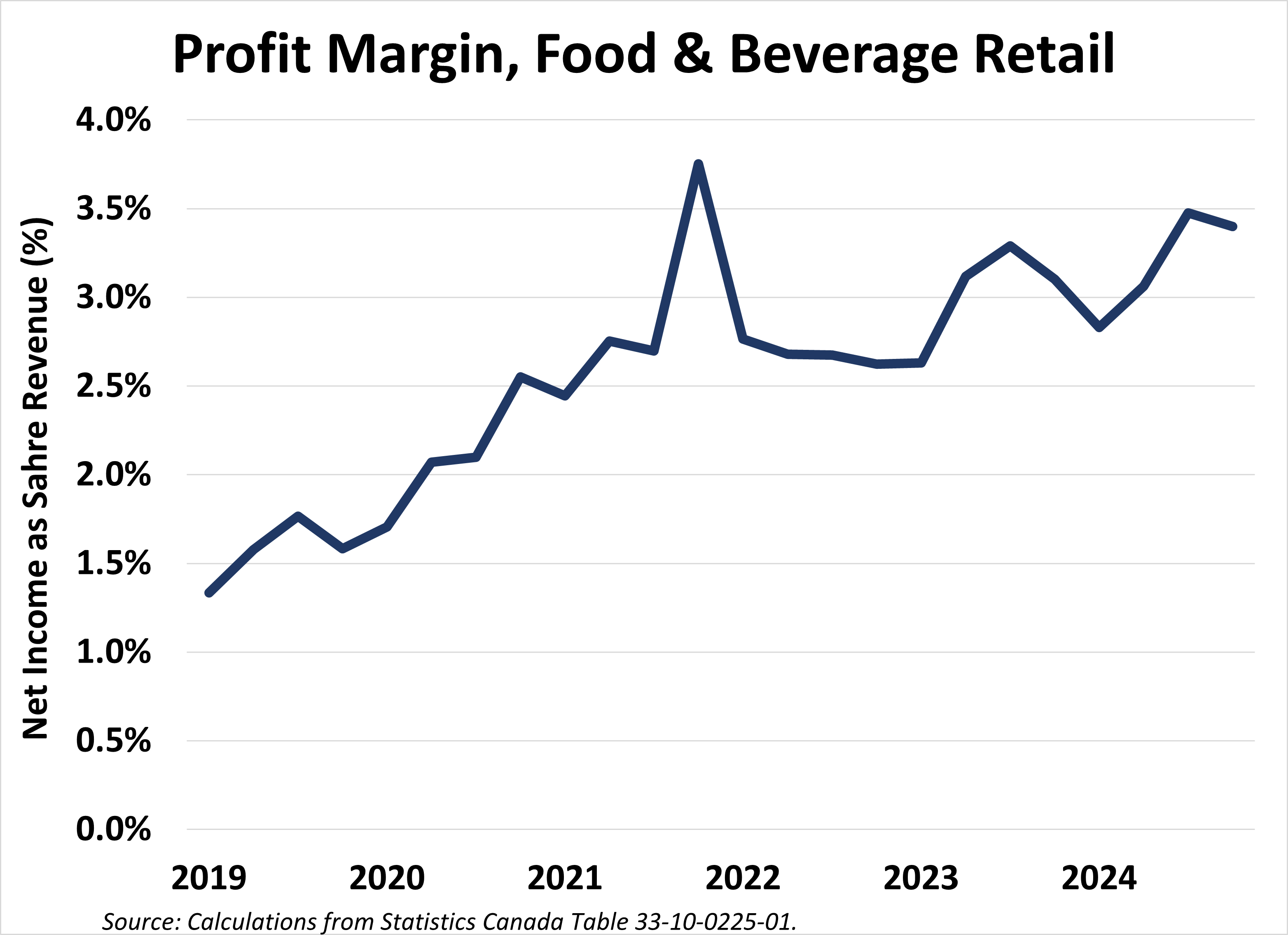
Supermarket CEOs and their apologists claim the growing mass of profits merely reflects the impact of growing nominal valuations, and that profit margins have not grown. This is false. As a share of total revenue, food and beverage net income has doubled, from around 1.5% of sales to over 3%. Some interpret this as evidence that food retail is a “low-margin” business, which is misleading. All the retailers do is buy food products from suppliers, put it on their shelves, and sell it. That’s why almost all retrial is “low-margin”, because the retailer doesn’t add that much value. But applied to a huge, stable flow of revenue (Canadians spend $200 billion on food every year), that “low margin” translates into enormous profits. Relative to invested capital (again, food retail is not a capital-intensive undertaking), this produces astronomical rates of return on equity: 25% or more.
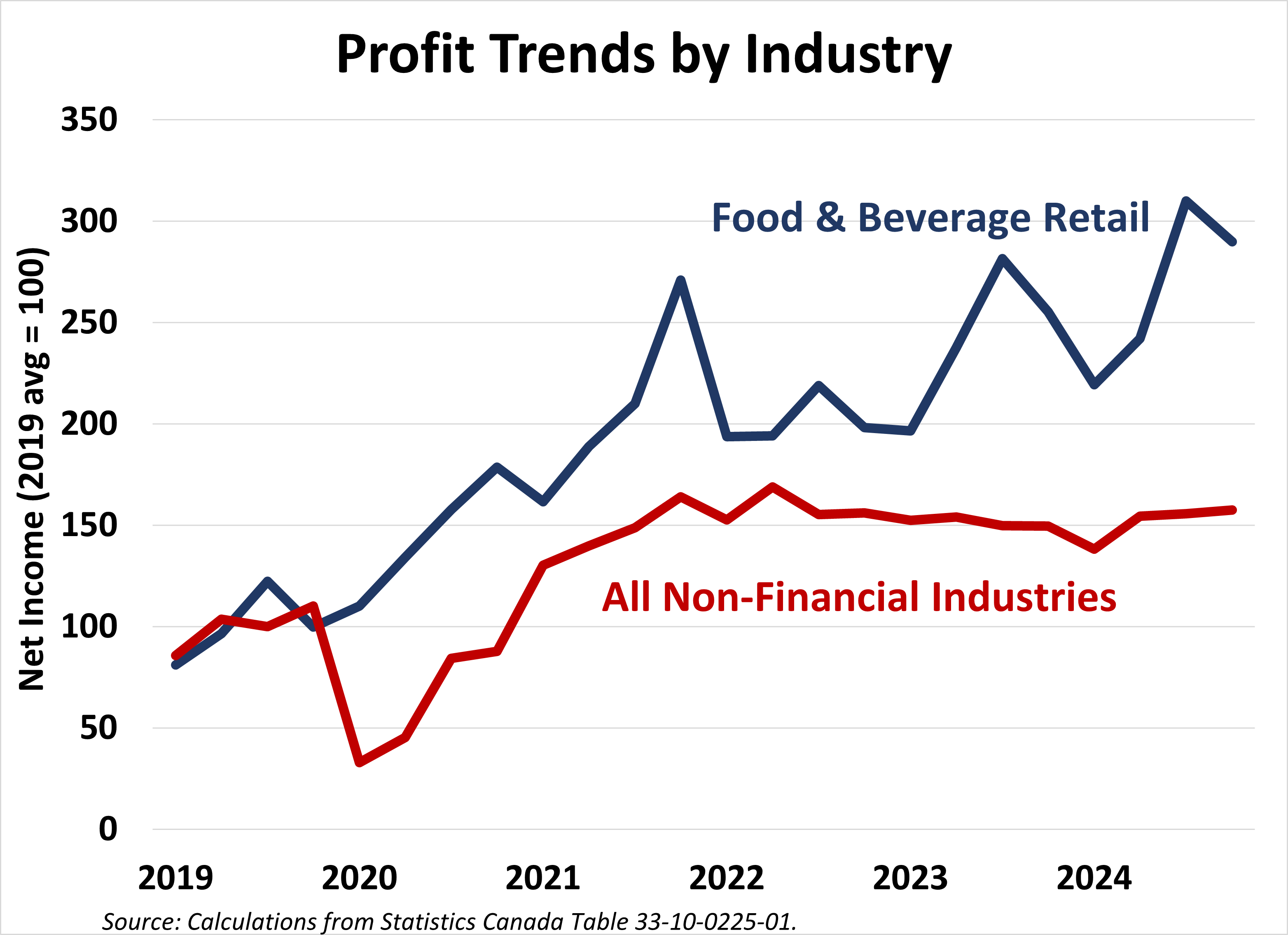
An interesting (and infuriating) thing about food retail profits is that they have not moderated, even during the slowdown experienced by the broader economy during the painful disinflation since 2022. Overall corporate profits in Canada moderated during the period of high interest rates (in the face of slowing demand and rising unemployment). Profits in food and beverage retail profit have continued to grow. 2024 was the best year ever for aggregate profits ($6.3 billion) and average profit margin (3.2% of revenue). The decline in agricultural commodity and input prices experienced in the last two years has not been fully passed on to consumers, and hence food retail profits have continued to widen. This likely reflects both the high degree of corporate concentration in the sector, and the inelestic nature of consumer demand for food.
So both the continuing anger of Canadians at what they pay at the grocery store, and the NDP’s promise to do something about it, are ratified by this data on the continued excess profits of this concentrated sector. Of course, trying to address this problem is not straightforward. The idea of some targeted forms of price regulation has been proposed and applied successfully in other countries (see my review of Kamala Harris’s similar proposal, and the experience of several European countries that have implemented similar measures). Singh’s proposal is a reasonable and timely proposal to address a problem that is real–no matter how much free-market true-believers try to pretend it isn’t.
]]>Here’s a ‘top 10’ overview of the report: https://nickfalvo.ca/subsidized-housing-for-francophone-seniors-in-minority-situations/
]]>A ‘top 10’ overview of the chapter can be found here:
]]>So, it comes with some irony that I find myself defending the economic policy legacy of the Justin Trudeau Liberal government nine years hence.
The acute drama that unfolded in December with the Finance Minister’s resignation ahead of a Skip-the-Dishes delivery of the 2024 Fall Economic Statement has been commanded by daily obituary writing by columnists and influencers seeking to consign not only the Prime Minister and his Liberal government and party to the dustbin of history, but their policy legacy as well.
This is a scandal. This is a shame.
I contend that since taking power in 2015, the Justin Trudeau Liberal Government*, has delivered the most important progressive economic legacy for Canadians in over forty years.
*with the support of the Jagmeet Singh NDP through the confidence-and-supply agreement that began in March 2022.
There has been sunshine from Centre Block.
I demonstrate this below by citing a selection this government’s economic policy achievements.
That I have not encountered more defenders of the Trudeau government’s economic record is highly alarming.
For what is at stake is not only these institutions established by the Trudeau government but the appetite of Canadian voters for progressive economic policy. The uninterrupted “everything is broken” mantra of the Pierre Poilievre Conservatives is cultivating a willingness to allow the delay, distortion and reversal of important economic policy actions needed for a just transition to a low carbon economy.
Climate and environment
Right up front, I begin with efforts to maintain the integrity of the Canadian and global ecosystem, in which the Canadian economy is embedded.
On climate change:
On protecting biodversity and reducing pollution:
Production
The Liberal Government has been chided for not begin serious about economic growth, focusing instead on distributive polices. This would ignore their important public investments as well as tax policies to enable private sector growth.
Distribution and Participation
These are not only about transfers but also about reducing barriers to fair participation, to being a more inclusive economy.
Indigenous
Women
People with disabilities
Children
Seniors
Access to affordable health services and products
Low-income workers
Tax policy
A “middle class tax cut”, which reduced the personal income tax rate from 22% to 20.5% on taxable income in the second tax bracket.
Introduced a new top tax bracket, which included a tax rate of 33% on taxable income above $200,000.
Monetary Policy
The 2021 agreement with the Bank of Canada on the renewal of the monetary policy framework for the 2022-2025 period shifted away from a singular focus on inflation to include consideration of the maximum sustainable level of employment when conditions warrant, and to report to Canadians on how labour markets outcomes have factored into the Bank’s monetary policy decisions.
Budget Policy
Sidestepping a commitment to balanced budgets gave the government the flexibility to fund these policies and programs above.
International
In response to the disruptions to trade regimes by the first Trump presidency:
Response to the COVID-19 Pandemic, 2020-2022
In less than a week after the country lock-downed for the first time, the federal government announced a $82 billion aid package on March 18, 2020. Much of the aid package was in the form of income support and financial aid programs, often in the form of taxable benefits.
Income support programs
At least six programs, including:
Employer/business support
At least five programs, including:
Do you agree with my list? Have I missed anything that should be included? Are these economic policies progressive?
]]>Newly released data for the third quarter of 2024 (July-September) shows the economy has continued to grow, albeit slowly. Consumer spending was the brightest light in the third quarter data: growing at an annualized rate of 3.5% (in real, inflation-adjusted terms), and constituting the largest single source of new demand.
Stronger consumer spending is being supported by continued rapid growth in wages. Average wages are continuing to advance at annual rates of 4-5% (depending on the specific wage measure chosen). Wages remain strong despite the rise in unemployment since 2022 (from 4.8% in July 2022 to 6.5% today), and the rapid slowdown inflation (now running at just 2% year-over-year).
This sustained strength in wages is surely causing much hand-wringing in both corporate boardrooms and at the Bank of Canada. It reflects the determined efforts of Canadian workers to win a fair share of the pie they produce: including through an upsurge in trade union action, and pressure (successful in most provinces) for significant increases in real minimum wages.
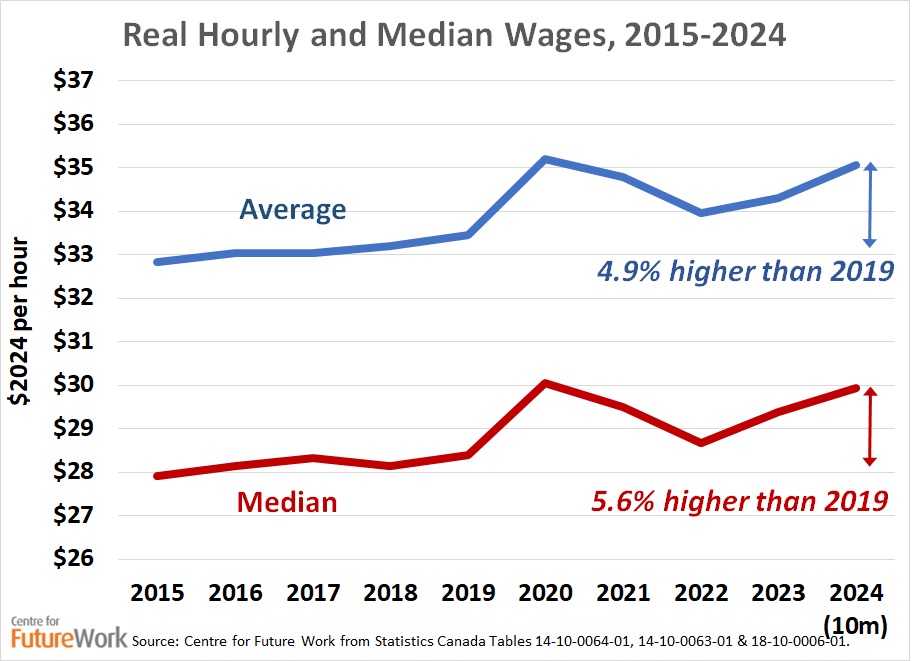
Wages have now been growing faster than prices for the last 18 months (and are currently growing more than twice as fast as the CPI). The resulting growth in the real purchasing power of wages has more than offset the decline in real wages that occurred during the initial outbreak of post-pandemic inflation.
Real wages are now about 5% higher than in 2019 (before the pandemic hit). Median wages have grown slightly faster than average wages, which indicates that proportional gains were somewhat stronger for lower-wage workers. (Please note that the 2020 peak in both series illustrated on the attached graph reflects a composition effect from huge job losses during the COVID pandemics, which disproportionately affected low-wage workers in retail, hospitality, and personal services; because of those job losses, the average wage for those who kept their jobs seemed to rise, but only until the return to work in those other industries pulled the average back down.)
The more-than-complete recovery of real wages in Canada after the pandemic is among the most successful of any industrial country. The U.S. is another country where real wages have recovered, even more strongly than in Canada – and, again, the strongest gains were received by lower-income workers. In contrast, real wages in most European countries and Australia remain several percentage points below pre-pandemic highs.
Thanks mostly to rapid growth in wages, household incomes have increased significantly in Canada in the last year: up by 7.5% in nominal terms, and over 4% in per capita terms. Again, that is significantly faster than inflation. That growth in incomes, combined with lower interest rates (which the Bank of Canada has now cut 4 times, for a total of 1.25 percentage points) and improving confidence, underpins relatively strong consumer spending. Barring another major global shock, it is likely these results will continue strengthening in coming months. (Unfortunately, there are many candidates for potential global shocks, ranging from Donald Trump’s threatened tariffs to escalation of war in the Middle East or Ukraine.)
These improving economic results stand in contrast, however, to a continuing sense in media and popular discourse that Canadians are angry and pessimistic about the economy. Political polls indicate the federal government is very unpopular (similar to incumbent governments in many other countries), with economic concerns seemingly top of mind for voters. Hyper-polarized social media, and the generally conservative bias of commercial mass media, reinforce the Conservative Party’s mantra that “Canada is broken” due to taxes, deficits, and general economic mismanagement.
This dissonance between positive economic indicators and persistent negative sentiment (especially expressed around politics) remains a puzzle to economists. Some traditional explanations do not hold water:
I believe the portrayal of rising real wages and strong household incomes above is an accurate depiction of what is happening in Canada’s economy. But as an economist, I cannot explain the contrast between those numbers and apparent sentiment. This negativity is especially visible in political surveys. In contrast, surveys of consumer economic sentiment (such as the Conference Board of Canada index) show gains in confidence this year.
A similar puzzle bedeviled the Democratic side in the recent U.S. election. U.S. economic performance since the pandemic was by far the strongest of any industrial economy (thanks in large part to very strong fiscal stimulus), and wide swaths of society experienced documented economic gains. But anger over the economy (perhaps fostered by negative reporting in the media, and virulent social and alternative media) was the major reason identified by researchers for gains in Republican support. (Claims of a Republican landslide, of course, are far-fetched: Trump received 50% of the presidential vote compared to 48.4% for Kamala Harris. Only in the U.S., with its byzantine electoral system, could this be construed as a “clear victory”.)
Two interesting journalistic reports have tried to make sense of the gap between economic outcomes and mass psychology. Ontario opinion pollster David Herle addressed the economic and psychological dimensions of the ‘affordability’ crisis in a recent episode of his influential podcast, The Herle Burly. The podcast featured myself and Armine Yalnizyan. Listen to our full discussion here.
In response to popular concerns about the cost of living, the federal government recently announced a temporary two-month ‘holiday holiday’ on GST payments on a selected range of products (including some prepared foods and children’s toys). In promoting this measure, Finance Minister Christia Freeland described it as an effort to combat the so-called ‘vibecession’: that is, persistent negative sentiment that, if it restrains consumer spending, could actually hold back the economy. (As noted above, consumer spending and reported sentiment are both growing, suggesting again that the ‘vibecession’ may be more of a concern in the political arena than in the actual economy.)
CBC journalist Abby Hughes pursued this idea of ‘vibecession’, including an interview with the U.S. economist who coined the term. She also interviewed me on the gap between economic and political indicators. Please see Hughes’ interesting feature article here.
Without being complacent about the challenges many workers face surviving in Canada’s harsh and unequal economy, the successes of Canada’s labour market institutions (like strong trade unions and higher minimum wages), which repaired real wages better & faster than most other OECD countries, should be acknowledged and, indeed, celebrated.
Defending and strengthening those institutions (which are now being targeted by Conservatives, and their “Canada is broken” mantra), and fighting for other policies to address bigger material challenges facing workers (especially the housing crisis, which needs a mass non-market strategy to resolve), may be a more progressive response to ‘vibecession’ than either temporary tax cuts or a simple-minded crusade to “throw the bastards out”.
The overarching task for trade unions and progressive political movements is to ratify the legitimate anger of working class people over their constrained life prospects (even if they are getting somewhat better, on average!), help them identify the main culprits for that situation (corporate power and greed), and then channel that anger in directions that will make life better for workers – rather than feeding a burn-it-to-the-ground mentality that is feeding right-wing populism here, and around the world.
]]>Here’s a ‘top 10’ overview:
https://nickfalvo.ca/covid-19-and-homelessness-planning-in-canada/
https://nickfalvo.ca/demand-side-housing-assistance-for-low-income-households-in-quebec/
]]>All course material is available free of charge at this link: https://nickfalvo.ca/courses/
]]>Here’s a ‘top 10’ overview of our analysis: https://nickfalvo.ca/economic-and-social-factors-associated-with-the-use-of-homeless-shelters/
]]>Here’s a ‘top 10’ overview of the report: https://nickfalvo.ca/report-finds-insufficient-daytime-options-for-people-experiencing-homelessness/
]]>A ‘top 10’ overview of the chapter can be found here: https://nickfalvo.ca/youth-homelessness/
]]>In this brief post, I’m going to describe what Canadian corporations are doing with funds acquired through issuance of debt and equity securities. I will be using StatCan data on corporate issuances of long-term debt and equity. Unfortunately, the data only goes back to 2020.
The StatCan data identifies five uses for funds:
The first two uses are operational spending rather than investment. The next two could be considered investment in building tangible and intangible assets. The final one does not add any productive assets to the economy. Instead, it concentrates control over existing assets.
Since 2020, almost 75% of all funds raised have gone to general purposes and debt operations.
Of the remaining funds, 76% were used for mergers & acquisitions, while 16% were used for exploration, research & development, and just 8% was spent on investment in productive assets.
As seen in the chart below, the share devoted to mergers & acquisitions has fluctuated over the years for which we have data. But it has never dropped lower than 60%.

There are many reasons why companies may favour M&As over investment in new or expanded productive capacity. However, one of them is uncertainty. With mounting, intersecting crises, as well as unclear technological development in many sectors, businesses are choosing to grow via the less risky path of M&As.
]]>Here’s a ‘top 10’ overview of the study:
https://nickfalvo.ca/comparating-municipal-spending-on-housing-and-homelessness-in-canadas-major-cities/
They call the vision a New Deal for Working People . The policy framework is called A Plan to Make Work Pay. Broad features of the plan were mapped out in the King’s Speech (akin to our Speech from the Throne in Canada) delivered yesterday, and include:
Strengthening the UK minimum wage policy to make it a stronger living wage. (Their minimum wage, introduced by Tony Blair in 1998, is already pretty good by international standards: it is equivalent to 57% of median wages, vs. 50% in Canada, and it’s kept up with inflation since 2019.)
Banning zero hours contracts (which currently cover >1 million workers).
Ending contract flipping / ‘Fire and Replace’ employment startegies (no details were provided on how).
Stronger access to statutory sick pay.
Flexible work hours as a normal right.
The speech’s language on reforms in the labour relations system is generic but positive:
“Updating trade union legislation so it is fit for a modern economy, removing unnecessary restrictions on trade union activity – including the previous Government’s approach to minimum service levels – and ensuring industrial relations are based around good faith negotiation and bargaining.”
Below is a backgrounder to the King’s Speech with more details, see especially pp 21-23.
My hopes were not very high for this new Labour government, given their very cautious platform. If they follow through on these reforms, however, then they are certainly heading in the right direction — which matters at this moment in history!
]]>Here’s a ‘top 10’ overview of what we learned:
https://nickfalvo.ca/affordable-housing-and-homelessness-in-london-england/
The legislation will take effect in June, 2025. It was supported by all parties in the House of Commons: Liberals, NDP, Greens, Bloc Québecois, and — surprisingly — Conservatives. The NDP negotiated support for this bill from the governing Liberals as part of their supply-and-confidence arrangement (which has kept the minority Liberals in power since the last election in 2012). While the Conservative party (like the Liberals) opposed this measure in the past, it decided to support the bill as part of its broader ‘makeover’ strategy to appear more anti-establishment and pro-worker.
The unanimous support for the bill is also testament to the public support which most Canadians currently express for unions and workers more generally. Unions were once scapegoated as self-serving, special interest groups, the cause of wage-price spirals, featherbedding, and lengthy strikes. In the wake of the pandemic, however, and the resulting cost-of-living crisis, more Canadians appreciate that workers have been victims (not the cause) of recent inflation, and are more sympathetic to workers’ efforts to win higher wages and protect living standards. Of course, there is still strong anti-union sentiment expressed by business groups and more ‘honest’ conservatives.
Of course, continued Conservative support for the new law cannot be taken for granted, if they win the next election. It is encouraging to note, however, that in the two provinces with long-standing anti-scab laws (Québec and B.C.) even right-wing parties did not dismantle the laws when they came into power. Perhaps the proven benefits of anti-scab rules in reducing the length of work stoppages and preventing picket line confrontations can be appreciated by a broader range of the political spectrum (but businesses will continue to push hard to win back the rich to hire scabs, understanding fully how this is a core part of their bargaining power). The federal law will also encourage other provinces to adopt similar laws: the new NDP government in Manitoba has pledged to implement anti-scab rules.
Winning all-party support for this historic measure is a very positive outcome, that reflects a conjuncture of advocacy and strategy:
This new law marks a welcome and important step forward in Canada’s labour relations law and practice. Workers in many other countries can hardly imagine a world in which they cannot be replaced during a work stoppage. In Australia, for example (where I also work), it is illegal to even call a replacement worker a ‘scab’ as they cross a picket line (on far-fetched grounds that this constitutes unfair ‘intimidation’) — let alone to try to stop them from crossing. This is a historic victory for workers in Canada that unions and their allies can rightly celebrate, while we prepare to defend it in the future.
Posted below is my testimony on Bill C-58 presented to the Senate Social Affairs Science and Technology committee which studied the bill (and recommended its adoption with no changes).
_______________________
The amendments to the Canada Labour Code and CIRB Regulations contemplated by Bill C-58, which would prohibit the use of ‘replacement workers’ to perform work normally undertaken by workers engaged in a duly constituted labour dispute, are a welcome step forward in Canada’s industrial relations regime.
Replacement workers are used during work stoppages to allow enterprises to continue production and business, thus protecting the stream of revenue and profits flowing to the business in question. By so doing, the use of replacement workers negates the bargaining power that workers attempt to apply to their employer, in a collective effort to improve wages and conditions.
I start from the fundamental principle that collective bargaining is a good thing. It offsets the inherent imbalance of power in the employment relationship between employers and employees, that derives from the fact that employers initiate and control production. In general, employers do not need any individual worker to operate their enterprise, as much as that individual workers needs their job to support themselves and their family. This dependence of workers on their employer empowers employers to extract more effort for lower wages. Left to the terms of one-on-one negotiations, wages will tend to decline toward subsistence levels.
The exchange between an employer and individual workers is thus a fundamentally unequal exchange, not an exchange between equals. It has been recognized in Canadian law for many decades that collective bargaining is not just a right, but is a necessary counterbalance to the unequal power of employers. Unions and collective bargaining, in this understanding, play a fundamentally important and constructive role in the labour market, by permitting a more equal relationship between workers and employers, and allowing workers to negotiate a higher share of the economic pie they help bake. In economic history, collective bargaining has been essential to the attainment of inclusive prosperity: that is, an economy in which average working people can enjoy a comfortable and reasonably secure life. Economies without strong collective bargaining systems – even developed industrial economies – exhibit great inequality and poor living standards for employed people who lack unique skills or other foundations for bargaining power.
Despite these broad economic and social benefits of collective bargaining, many employers try to avoid or resist it – for the simple reason that it generally leads to higher labour costs and constrains the unilateral authority of employers in the workplace. There are many ways for employers to avoid collective bargaining: including interfering with or opposing unionization campaigns, relocating work to non-union facilities or countries, outsourcing work to non-union suppliers, or converting their employees into contractors, labour hire workers, or platform workers.
Using replacement workers during a work stoppage is another way for employers to try to defeat collective bargaining. If, in the event of a work stoppage, the employer can carry on business anyway thanks to the use of other non-union workers, then the balance of power in bargaining is tilted dramatically. The employer is empowered to ignore or resist union demands entirely, and carry on business as usual. In effect, the employer can use a work stoppage, potentially provoked deliberately, to step outside of the collective bargaining relationship entirely. Knowing that this can happen hardens employer attitudes, and constitutes a major impediment to genuine and constructive collective bargaining.
In addition to this negative effect on the bargaining relationship, the use of replacement workers has other painful outcomes: including prolonging labour disputes (and resulting lost income for workers involved), and increasing the risk of spillover disruption, confrontation, or even violence on picket lines. Of course, violence is not acceptable in any circumstance, but a labour relations regime which provides employers with the right to continue to operate despite a duly constituted work stoppage clearly enhances the risk of such an outcome – and there are too many instances in Canadian labour history of this occurring.
Some employers worry these reforms will unleash a wave of strikes that will disrupt the economy and weaken productivity. There is no empirical evidence to support this concern. Work stoppages in Canada have certainly been more common in the last two years, due to the disruption caused by the acceleration in inflation and the resulting decline in real wages. But in historical context, work stoppages are nevertheless still very rare.
Last year was the worst year for work stoppages in decades. Yet days lost in work stoppages still accounted for barely 0.1% of total days worked in the economy. And in the first four months of 2024, days lost in major work stoppages have fallen 63% from the same period in 2023. Over the last decade, the proportion of working days lost to work stoppages (including employer lockouts, which were very common in the mid-2010s) was about 0.04% – the lowest for any 10-year period since World War II. That is one tenth as frequent as was the case in the 1970s. In other words, the frequency of work stoppages has declined by 90% since the 1970s. This trend reflects the decline of union representation in the private sector of the economy (down to 16% according to most recent Statistics Canada data), and other law, regulatory, and economic factors which have weakened the bargaining position of workers and their unions.
There is a limited amount of scholarly research on the impact of prohibitions on replacement workers on the incidence and duration of work stoppages, based on experience in Quebec and B.C. (where these laws have been in place for some time). There is no evidence of a statistically significant and sustained impact of these measures on the overall incidence of days lost to work stoppages. Some evidence suggests that work stoppages are more frequent, but of shorter duration, when replacement workers are prohibited, with no net effect on days lost to work stoppages. Some evidence suggests that these measures are associated with higher private sector wages, which is consistent with the story I have told about the importance of effective collective bargaining in lifting wages.
In sum, this legislation is an important step forward in Canada’s industrial relations architecture. It will reinforce the integrity of collective bargaining, which plays a vital role in the attainment of a more inclusive and fair economy.
]]>This lecture was delivered on May 31, 2024, at the Canadian Economics Association Annual Meetings, Toronto Metropolitan University
Thank you for the immense honour of being awarded the Galbraith Prize in Economics — and for agreeing to wait a year to hear this speech in Toronto instead of Winnipeg. Some of you know why the delay occurred. Others can find me later and I’ll tell you the story over a beer.
For the past six years I’ve lived in Ottawa, on the unceded territory cared for by the Algonquin Anishnaabe people for hundreds of years, just as it has taken care of them.
I live on the Ottawa River, where no two days are alike. The river constantly changes, shaped by what is happening upstream, and how the downstream gets blocked or opened. Some days the river is swift-moving and of singular purpose. Others, change laps languidly, almost aimlessly at the shore.
It reminds me of the changes I am seeing in the care economy, where I have devoted a growing share of my time as the Atkinson Fellow on the Future of Workers. The pandemic spurred this evolution in my focus, and I’m so glad it did, because demographics will inevitably nudge a growing focus on the care economy’s role in economics, and someone needed to drive attention to that evolving reality in Canada.
The events of the last few years – pandemic, inflation, central bank rate hikes, increasingly polarized politics – have also made me think about our profession, and how change happens in economic thought and economic policies. Things seem constant … until they change.
Sometimes change creeps up on you. Sometimes it hits like a tsunami.
Sometimes system shocks –war, or climate change, or political upheaval, or just bad planning – urge change to happen. Sometimes people do.
What kind of people? Our focus often gravitates to the giants.
The namesake of the Galbraith Prize, John Kenneth Galbraith, qualifies. He stood six foot nine inches tall. In the 97 years he strode this earth, he cast a long shadow on our profession and changed the meaning of what it meant to be an economist. A popular economist. That is, an economist who could be understood by a non-economist.
But Galbraith was not just popular. He was an economist who made a difference in the lives of almost everyone. An economist who changed how economists use our skills, and for whom. The story of Galbraith is a story of evolution, of economic thought and economic policies, of economic relevance. In the next few minutes I hope to remind you that it’s when someone challenges and recasts the definition of economic relevance, change happens. You could be that person.
Today I will tell the story of the evolution of economic thought, and the story of the evolution of the care economy. It’s a story littered with both light and dark giants, humanizing forces and destructive influences. The characters populating these dynamics change, and so do the arenas of action. Every Goliath has its David. For me, the dark giant I am battling is the ascendant power of private equity in the care economy.
Giants have been part of our storytelling as long as we’ve been telling stories. Sometimes they are portrayed as violent monsters, sometimes as intelligent and kind. Leaders, even. Often depicted in counterpoint to our own more modest stature, stories about giants can remind us of our sometimes-surprising strengths. They always reinforce that it matters how power is used, in whatever size and shape it appears.
But even giants stand on others’ shoulders, and before the Giant of Galbraith, there was Alfred Marshall.
Like Galbraith, Marshall was a social economist. Born in 1842, he waited almost half a century to be influential. What did it mean to be a social economist then?
The first Great Depression gripped the richest countries of the world from 1873 to 1893, spawning dozens of revolutions, and ultimately World War I. It was in amidst this era of tumult and turmoil that Marshall literally wrote the book on economics.
Principles of Economics was published in 1890 and introduced the concepts of demand and supply, price elasticity, diminishing returns and marginal utility. Galbraith said the 800-page tome was the first book on economics he ever read.
Marshall was the father of neoclassical economics and introduced the foundational concepts of microeconomics, defining our field of study for the next half century or more. Before Marshall, no one used charts, or explained how demand intersected with supply. Before Marshall, economists didn’t think about fixed and variable costs, or decision-making over short and long periods.
Marshall reconciled the classical theories of value with modern theories of price, based on the actual costs and processes of producing things.
It was no marginal revolution, if you’ll excuse the pun. He embraced the Industrial Revolution’s newly ascendant engineering concepts of optimization and maximization and used mathematics as a tool to simplify ideas. But if math could not “illustrate the examples that are important in real life…burn the math”.[1]
What made Marshall a social economist was his mission to explain human behaviour.
If the practice of economics is like a poker game – who can play and bluff their way to winning the game of explaining the world to the world – then Galbraith saw Marshall and raised him one, implicitly at the beginning of the Second World War, and explicitly not long after.
Aware of its power, Galbraith was deeply critical of the ways economic theory lagged economic realities. Economic thought shapes public policy and practice. Galbraith shaped both, for decades.
His forte was empirical work. Evidence-based. Of the moment. News you can use. That’s why millions of “regular” people paid attention.
Son of a farmer in Iona Station, Ontario, he was raised to be relevant, and based his work on what people needed to know. His roots on the farm and in agricultural economics shaped agricultural policy in the Roosevelt administration during the 1930s.
During the Second World War, he headed the Office of Price Administration, which imposed limited price controls during World War II. Wartime production saw nominal GDP soar by 75 percent in four years. But inflation only increased by 3.5 percent, a truly astonishing feat. When the controls were taken off, in June 1946, inflation soared to 28 percent.
(As an aside: Dr. Isabella Weber was in town last night, delivering the Ellen Meiskins Wood Lecture. Her reminder of the power of price controls was met with a firestorm of derision in 2021. By 2022, though, both Europe and the U.S. had introduced policies that adopted this approach. Watch for my profile of this incredible mind-changing economist in the Toronto Star next week! Fun fact: Weber learned her trade at none other than the Marshall Library of Economics at the University of Cambridge. Giants can teach giants how to giant! It was an honour to meet this young woman economist with a spine of steel, and I can tell you without doubt – watch this space. She’s incredible.)
After the war Galbraith started writing about the evolution of markets. You know, what was actually happening, not what textbooks told you should happen.
American Capitalism (1952) documented how the neoclassical model of perfect competition missed the big story: the rising power of big corporations. This, he noted, could only be held in check by the “countervailing power” of governments and labour unions.
The Affluent Society (1958) coined the now well-known term, “conventional wisdom,” referring to the “esteemed acceptability” of well-worn but irrelevant ideas that accompanied the ascendance of unthinking conservatism. A key takeaway was that private affluence does not abate public squalor. Indeed, private growth is often accompanied by public decline. File that lesson away for later.
In The New Industrial State (1967), Galbraith meticulously documented how corporate America was morphing into mega institutions that held sway over public policy and our lives. There are lessons to be learned today from that analysis regarding the rise of private equity, which I’ll get to in a moment.
Galbraith’s influence in the corridors of power may have peaked by the 1960s (already by January 1961, Paul Samuelson was the author of the report on the State of the American Economy to President-elect Kennedy) but his influence on the public imagination and discourse continued to rise.
His wildly successful PBS TV series, The Age of Uncertainty, launched in 1977, was based on the book of the same name.
By this time, Galbraith was arguably the most widely read, heard and seen economist in history. A central economic teaching was to clarify the respective roles of markets and governments; twin engines of economic capacity that could either maximize growth or maximize utility, or what we might today call quality of life. The balance between governments and markets determines economic outcomes for individuals and societies.
It was not long before Galbraith’s analysis and purpose were challenged by another giant. A giant named Milton Friedman. Standing at an imposing five foot three, Friedman was a contemporary of Galbraith. In fact, during World War II he rowed in the same direction as Galbraith and Keynes, economically. He was hired by the Treasury Department to help introduce the system of federal payroll tax withholding that helped finance the war effort.
Maybe he never got over it. The rest of his life was an unending campaign to restrict the state’s role, increase rights and reduce responsibilities of individuals and corporations.
It is unclear who will cast the longer shadow over the 21st century, Galbraith or Friedman.
In 1970, Friedman published a free market manifesto in The New York Times magazine entitled “The Social Responsibility of Business Is To Increase Its Profits.”
Friedman followed Galbraith’s wildly successful 1977 TV series and book with his own clapback. Free To Choose was also launched as a TV series and book. They came out in 1980, around the same moment as Thatcher and Reagan.
The three went on to dominate economic thought and popular discourse for the remainder of the decade. In the battle for balance between government and markets, the tide had turned.
It has now been over 40 years since the economic nostrum of “more market, less government” took hold. Galbraith noted “Milton Friedman’s misfortune is that his economic policies have been tried.”
He went on to say: “We can safely abandon the doctrine of the eighties, namely that the rich were not working because they had too little money, the poor because they had too much”.
Trickle-down economics should indeed be abandoned. It hasn’t delivered on its own terms. Now an aging population, a global pandemic, climate chaos, and the escalating sabre-rattling of increasingly fractious geopolitics call for more, not less government. Yet resistance is fierce. Old habits die hard.
As Marshall, Galbraith and most of you understand: the most relevant economics explains human behaviour, helping us identify macro patterns and trends that result from the accretion of millions, even billions, of micro decisions, and how the macro shapes the micro choice set.
Galbraith’s thinking evolved as he plunged into the realities of farmers’ decisions, governments’ decisions, military decisions, and corporate decisions. His empiricism challenged orthodoxy.. That’s the right way to challenge ideas: the what-is, not the what-ought-to-be.
As we learned from the inaugural Galbraith Prize in Economics lecture in 2007, delivered a year after Galbraith’s death by his son, Jamie – himself a professor of economics at University of Texas, Austin – Galbraith wove an intellectual fabric from many different economic threads over the course of his life.
In the intervening years we’ve heard from eight other Canadian economists whose lectures have brilliantly illustrated the remarkable spectrum which Galbraith’s thinking spanned and spawned, revealing the colours and texture of progressive economic thought.
Kari Polanyi Levitt showcased the role of data, leading to the financialization of economics and financial crises; Mel Watkins described free trade as a bad religion that interrupted genuine human development; John Loxley took us on a journey of continuity and change at the IMF; Mike McCracken reminded us of the centrality of the pursuit of full employment; Lars Osberg explored the limits of steadily increasing inequality; Marjorie Cohen Griffin reminded us of the “appalling” masculinity of economic analysis; Jim Stanford produced a program for building a better global world order; and Mario Seccareccia called for a paradigm shift in “conventional wisdom.”
Today’s era of polycrises, with overlapping challenges facing individuals, communities, businesses and governments, provides no shortage of new empirical realities that make for meaty topics for economists, as this year’s Canadian Economics Association meetings amply illustrate.
The pandemic shifted my attention to the one thing we all need at different points in our lives, from cradle to grave: care. The human need for care is a constant. The way we access care is changing rapidly, affecting almost everyone. And that, in turn, affects how the economy at large works.
I have become increasingly concerned by the ballooning size and influence of markets in the domain of care, and the growing role of investment capital, particularly the kind that we know so little about in Canada: private equity.
The care economy matters more than ever. It is evolving, and how it evolves matters to all of us.
Just as Galbraith used his historic moments – the war, the post-war wave of corporate consolidation, soaring poverty amidst expanding prosperity – to explain how economic systems work, and how they could work, this moment demands we as economists pay more attention to the care economy.
I hope the next few minutes of this lecture will convince you of this urgency.
Caring has long been seen as a woman’s issue. It took forever to get the care economy on the political agenda, especially in Anglo nations because historically care has primarily fallen to women to care at home for those too young, too old or too sick to work. This was most often the case when one breadwinner could support a family, and that breadwinner was most often a man.
Caring only recently became viewed as an economic issue of consequence. That’s for two reasons: 1) More working-age people are turning to paid care supports because they have to work to survive. They are unavailable to provide unpaid care. 2) The system of care is in crisis. Almost everyone has witnessed how the undersupply of care underscores the degree to which it is a foundation for virtually every other aspect of human endeavour.
My focus is on the aspects of the care economy that are in becoming profoundly dysfunctional: childcare, long-term care and healthcare.
But beyond its role in our lives is its relevance to the economy. That’s very odd, because it plays such an outsized role as an input to the economy. Citizens and governments go nuts when roads and bridges are washed out, or electricity grids collapse; but social infrastructure is as critical to daily functioning as physical infrastructure. Witness what happens when childcare centres, long-term care facilities, primary care clinics and hospitals can’t serve our needs.
You may be surprised by the facts. Most people are.
To describe its scale: combine Statistics Canada’s measures of the industry of health and social assistance with the industry of education. (The health and social assistance sector includes long-term care, childcare, hospitals, homecare and primary care.) Together these two sectors contribute to and ultimately define human development and the economic potential of individuals and whole societies. That definition of the care economy accounted for 13.4% of GDP in 2023. Its closest rival is real estate, which clocked in at 13.2% of GDP.
In 2023, the care economy was over a third (38 percent) bigger than all manufacturing (9.7 percent); almost twice as big as construction or finance (7.5 percent); and almost three times as large as the mining and quarrying sector (5.1 percent), which goes well beyond oil and gas.
You’d never know it from the way the business press and decision-makers talk. Economic growth and productivity are rooted in exports, innovation, and investments in machinery and equipment in this view of the world. So much thought goes into the production of cars, oil and new homes; yet the care economy, already a dominant source of growth and innovation that could transform the economy and lives, faces chronic disregard and underinvestment.
Nonetheless, demographics and the increasing privatization and profitization of care have expanded the footprint of formal, monetized care in the economy over the last 20 years; and it’s growing, still. Indeed, the care economy may become the biggest single driver of future economic growth in the slow growth environment that is gripping every nation that had a baby boom after the Second World War, and falling birth rates since.
I’m going to say that again: the care economy may become our biggest driver of future economic growth. Wow, right?
And here’s another “I bet you didn’t know”: the care economy already provides over one out of five jobs in the economy (21 percent), eclipsing all other industrial sectors of the economy as a source of income for Canadian workers.
The care economy has the potential to become the backbone of the Canadian middle class, just as manufacturing was in the 1950s and 1960s. As in manufacturing, the goal is to make every job a good job. Or at least more of them.
We treat the care economy as a derivative part of the economy, a nice-to-have once we’ve dealt with the “real” public policy priority, economic growth. But economic growth can’t be sustained without the care economy. Delivered with or without love, care is the foundation of economic growth.
Economists debate whether the richest nations in the world are entering an era of slow growth. I mentioned three drags on growth earlier: population aging, climate change and increasingly fractious geopolitics. Investors are finding it harder to make money from endogenous, organic growth, not only domestically but at the global level. A lot of money was made during the pandemic, and a whole lot more when the global economy reopened after the pandemic, Russia invaded Ukraine, and a wave of inflation not seen in 40 years was unleashed on the world. But that spike in profitability had two features: it was temporary, and a lot of that money migrated from the usual types of investment – publicly traded stocks and bonds – to private equity.
Private equity is a form of capitalism that is hard to monitor. That spells trouble for us all.
You may recall Canada’s federal finance minister saying in the fall of 2022 that she was being “fiscally responsible, keeping our powder dry” to explain why she wasn’t increasing federal spending to support those struggling with inflation-induced affordability issues. She wanted to reserve funds to deploy if the economy fell into recession.
There’s another, far more explosive form of “dry powder” and it’s not being held in reserve to help you. It’s the term used in private equity markets to refer to cash ready and available to be put to work to make money for its owners, not you.
How much dry powder is available in the world of private equity is a question mark because – by definition and by law – it’s private. We only know what these investors want to tell us. Estimates from Prequin and Dealbook put the amount of dry powder available in early 2024 as approaching or exceeding $3 trillion USD globally. And that money is increasingly eyeing the care economy.
Just a few weeks ago, a huge conference in Washington DC brought together thousands of investors to talk about the potential for dealmaking in the homecare and long-term care businesses. In early March, Lina Khan, chairperson of the U.S. Federal Trade Commission, put the investment world on notice that, given the acceleration of private equity deals in anesthesiology, which consolidated market power and drove up prices across the entire acute care system, more interventions and possibly new regulation may have to occur to prevent that contagion from spreading. Meanwhile, the U.S. Senate is studying how private equity has advanced to own a quarter of all U.S. hospitals, changing costs and access in the process. California just tabled a bill that aims to lock private equity out of health care.
Here in Canada, we are walking towards a world of pain with our eyes wide shut.
We need to pay much closer attention to trends in private equity in the U.S., U.K., New Zealand, Australia, Europe, the Nordic nations, and in South Asian nations. The same patterns are playing out around the world. They reveal two truths, learned at high cost in the past few years.
Truth 1: Care workers go to work so that you can go to work. If there aren’t enough care workers to do the care that is needed, other workers will be unable to work to their potential. They will need to provide some amount of unpaid care. That will undermine the latent economic potential of a nation.
Not to fetishize paid work, but we are in a new moment. Soon, one in four Canadians will be seniors, the biggest cohort of elderly in history. The dependency ratio will be the highest it has been in 60 years, when the boomers were born. It will continue not for a few years, as it did in the 1950s and early 1960s, but for decades; and this reality will unfold against a background rate of economic growth not of five or six percent, as was the case more than half a century ago, but with growth hovering around two percent or less. It won’t take much to push the system into long-term recession if we don’t get this right.
This is happening around the world as well: rapidly growing demand for paid care services, rapidly growing government financing and a light touch on the rules, to facilitate a rapid expansion of supply. The care economy is turning into an economic wild west.
Truth 2: These are the perfect conditions for attracting private sector investors. But not just any kind of investment. Not publicly traded companies, by and large, who are regulated by security commissions, but private equity, for whom there are fewer legal requirements and fewer legal restrictions. They work within the rules (or lobby to change the rules) to shield themselves from scrutiny, responsibilities and liabilities through complex corporate structures.
As I have learned from my own recent look into private equity investment in the long-term care and childcare sectors, taxpayers and economists now need forensic accountants to help us follow the money. Taxpayers’ money. Our money. And there’s a lot more money to come. The business of childcare alone is expected to double globally by 2030 (less than a decade!) to almost half a trillion dollars. But governments aren’t tracking what’s happening here. Neither are academics. Or journalists. Or think tanks.
Governments and economists may be moving slowly, but these private equity giants are flying high and moving fast. A private equity asset is held on average for four to seven years before it is sold.
The care economy is an appealing target because, in the era of slow growth, it is a sure source of organic growth, and provides a guaranteed, government-backed stream of regular revenue.
Billions of taxpayer dollars are being unleashed in Canada, the UK, the U.S. and the Anglosphere in general as societies struggle to address the twin pressures facing smallest cohort of working age people in 60 years: high costs of care colliding with a high need for workers. Improved affordability and access, not profit, are the goals. But when billions of dollars suddenly appear, so do the profiteers.
Further, virtually every aspect of the care economy is ripe for the private equity playbook, with high potential to squeeze profits by lowering costs, increasing revenues, and lobbying governments for new rules regarding staffing levels and qualifications, as well as fee rates.
Economists often debate the pros and cons of privatization. This isn’t your daddy’s privatization, and these aren’t your typical corporate giants, either. Small-cap private equity create the chains, which are bought by big-cap private equity firms. The game is ever-accelerating corporate concentration, and a faster rate of bankruptcies. Private equity is creating a new type of vulture capitalism momentum everywhere, and its coming for the care economy.
Though private equity comes in different sizes – family offices, institutional players like pension funds and banks, and other alternative investors, small cap, big cap – only deep pockets can come to the table. It’s a big stakes game. The lowest ante I’ve seen is $100,000. That’s what Wealthsimple says you need to have to even think about playing. But Wealthsimple is a bit player, taking a gamble to bring private equity ‘to the people’. The entrance fee to this world is usually in the multi-millions. Don’t call us. We’ll call you.
Private equity is a ruthless, even monstrous giant, because it’s always a big-foot strategy. Few of these investments produce more care, that is, add capacity. They are mostly “roll-ups,” purchases of existing operations with known capacity, revenue flows and profit margins. The “bigger is better” strategy of adding companies to one owner produces economies of scale in back-office functions, supply chains for bulk purchasing, standardized procedures to minimize costs and maximize revenues, and extra-billing for anything but the most basic service.
That’s all key, but the biggest payout comes from extracting higher rents (a sad irony for the many operators that sell their business with real-estate assets) and saddling the acquired companies with the debt payments used to buy them in the first place.
The pattern repeats with each sale – mergers and acquisitions grow market share, lower costs come from economies of scale and cheaper payroll costs, higher revenues come from using growing market share and/or captive markets (with little or no options) to set prices. But this recipe for success has its limits.
What happens when you can’t juice more profit out of the enterprise? It goes bankrupt. The Body Shop and Red Lobster are just two recent examples of successful brands unable to survive the rapacious appetites of takeover by private equity. This storyline has been repeated for decades and is now mushrooming across new sectors of the economy, including the care economy.
When it comes to the business of care, the extraction of profits always reduces the potential amount of care people receive, primarily but not exclusively through cutting labour costs by lowering staffing levels, reducing qualifications, eliminating benefits and pensions. As Canadian sociologists Hugh and Pat Armstrong have said for decades, “the conditions of work are the conditions of care.”
Just this week CBS aired a two-part series on how the arrival of private equity in the U.S. long-term care sector is leaving the elderly with sub-standard care and a shrinking set of choices as more facilities go bankrupt. In my Toronto Star column, I did the same analysis in Canada by examining how this model of acquisition is stripping real estate values from our long-term care homes, jeopardizing care by reducing staffing or simply closing the operation to build condos. Wait lists for care are soaring, with consequences spilling back upstream across the whole system. We taxpayers are left paying for this mess.
The Norwegians call it the tapeworm economy, parasitic investments that grow in size as they absorb nutrition from public funds, weaken care and degrade jobs.
In Canada, at best we’re sleepwalking through it; at worst, actually, we’re rewarding companies that are providing allegedly criminal levels of long-term care, as I documented in another recent Star column.
Not just big in scale, these big-foot owners are proliferating in number across the economy. They are the new giants of capitalism…and now care. The same patterns are unfolding across long-term care, hospitals and homecare, and childcare in nation after nation: public and non-profit operators are struggling to keep things running while private investors reap growing profits. All fuelled by the public dime.
In Canada, we’re not learning fast enough from others’ experiences to meaningfully apply the brakes. The U.K., the U.S., and Australia have all seen private equity investment rip and strip their way through multiple sectors of the economy for two decades or more.
Sadly there are many, many, many international examples of how overleveraged owners drove successful operations into the ditch, but in the care economy, the consequences are starkly different than from retail or restaurants or journalism.
Paid care is already chronically undersupplied. What happens when the enterprise that goes bankrupt serviced the care needs of 10 or 20 percent of a community? Who will take care of pre-schoolers whose families require all available adults to work? In long-term care, more elderly are being evicted from their nursing homes so owners can cash in on the real estate bonanza, but there’s no other capacity to turn to. Where will people without supports or bags of money live out their lives? And what will it mean to productivity and GDP per capita when the smallest working-age cohort in more than half a century can’t get their own healthcare needs met?
The dynamic now at play in the care economy has terrible human consequences. It has devastating economicconsequences too, on workers who provide care and workers who need paid care to be provided. When the inevitable happens – accelerating numbers of companies providing care bought and sold by private equity, driving more of them to collapse — the disruption faced by individuals and the economy at large will be fearsome.
The care economy is too important – economically and at a deeply personal level – to surrender it to market forces.
Galbraith knew this. He worried about “our tendency to overinvest in things and underinvest in people.”
That’s my worry too. We need guardrails on our public investments to make sure our money is being used to finance our long-term needs/interests – caring for each other – and not some investor’s short-term gain.
We can wait for these predictable disasters. Or we can pay attention to how the story is unfolding in other nations and learn from their defensive strategies.
This isn’t a murder mystery. We can write the next chapter of this story. We know what needs to be done.
One of my favourite Galbraith quotes is this: In all life one should comfort the afflicted, but verily, also, one should afflict the comfortable, and especially when they are comfortably, contentedly, even happily wrong.
Today, the comfortable contented are afflicting the afflicted. It’s a situation light on poetry and hard on the soul.
But, as Galbraith said about Marshall – “you had to know what was wrong before you could know what was right”. Empirical evidence and good theory help prevent oversteering, in any direction. We don’t have either at the moment.
We need all orders of government to monitor these investments and provide transparent reports to the public.
For that to happen we need to change laws to require more disclosure. For a start, if a corporation receives public funding to provide care, it should have to disclose:
We also need to place limits on market shares. Perhaps a threshold on the number and scale of operations held by a single owner. Perhaps market share in a given geographic catchment area. Few categories of consumption are more inelastic than the demand for paid care. What does that mean? We’ll pay whatever we have to pay, or do without. This is third world public policy.
Given how debt charges are a leading cause of bankruptcies in acquired facilities, there should be limits on the amount of debt used to purchase care operations. Would-be homeowners need to put down 20% of the purchase price of a home, or purchase mortgage default insurance and pay higher borrowing fees. We should exact similar rules when it comes to the purchase of care facilities.
That giant sucking sound you hear is the withdrawal of dividends and fees from the revenues of acquired companies, irrespective of what that means to the provision of care. In some cases this has bankrupted operations within months of new ownership. In the U.S. there have been federal bills tabled barring the extraction of dividends (and further outsourcing, often to other companies owned by the shell organization) for two years after purchase. Finally, we need to come up with a system-wide plan – across childcare, healthcare, and long-term care – that ensures we have the right person to do the right job at the right time, and that we train, attract and retain the right number of people, along with the right labour-enhancing technologies.
Marshall intersected demand with supply. We need to intersect capital and labour in the care economy, and treat both as potentially transformative.
Galbraith showed us how real-time information should evolve our critiques and economic thoughts, and emphasized that thinking can’t be the only end result. A better world needs action, too. It is certainly true that there is plenty of action on the other side of the ledger among the dark giants of private equity, so we need to level up — on behalf of society’s most vulnerable, as well as, let’s face it, our future elderly selves.
As economists, we need to follow the money and reveal the micro and the macro of this transformative moment. There are plenty of ways to challenge the orthodoxy about the balance between governments and markets, plenty of ways to alter the river’s flow, to bend its course.
And don’t worry if you’re a shorty, like me. You don’t need to be a giant. You just have to be willing to stand up to them.
[1] [1] In a letter to the statistician Arthur Rowley in 1906, Marshall wrote:
“(1) Use mathematics as shorthand language, rather than as an engine of inquiry. (2) Keep to them till you have done. (3) Translate into English. (4) Then illustrate by examples that are important in real life. (5) Burn the mathematics. (6) If you can’t succeed in 4, burn 3. This I do often.”
]]>The corporate defence is that they are just passing along higher costs. However, during the Parliamentary testimony of Canada’s grocery CEOs, Loblaw’s then-CEO, and still Chairman, Galen Weston offered a general defence of corporate profits to justify the record profits that his company was collecting: “Over $2 billion is going to be reinvested back into this country. It’s not just about profit. It doesn’t go to me. It goes back into this country.”
This raises the question of how much corporate profit gets reinvested.
Let’s set aside the issue of whether corporations are the right decision-makers on the investments that would best serve the public. Let’s just follow the money to identify what publicly-listed, Canadian-headquartered corporations have been doing with their profits.
Profits are the difference between revenue and costs. However, there are several financial measures that can reasonably be called “profits”.
First, there are “gross profits”. This is revenue minus cost-of-goods-sold, which are the expenses for material and labour inputs to production.
Next, there are “operating profits”. This subtracts additional operating expenses, such as marketing or administration, from gross profits. Operating profits also get called EBITDA, which stands for “earnings before interest, taxes, depreciation, and amortization”.
Third, “pre-tax profits” or “pre-tax income”, are after deducting interest, depreciation, and amortization, but can also include the addition or subtraction of non-operating income and expenses.
Finally, “after-tax profits” or “net income”, are after deduction of corporate income taxes (CIT). This is the actual “bottom line”.
There are legitimate reasons to use different measures of profit depending on the analysis. For example, financial analysts often use EBITDA because it gives a better picture of a company’s cash flow from core operations.
The analysis that follows will focus on how operating profits have been distributed. This is the highest level of profit that can be consistently analyzed over several decades using the chosen data source. Unfortunately, until recently, many companies did not report the cost-of-goods sold separately from other operating expenses. Operating profits tend to be less volatile that pre-tax or net income and serve as a useful denominator to assess how profits are being used.
The profit margin measures a firm’s profits as a share of revenue. In other words, it expresses how much of the revenue is being claimed as profit.
Figure 1 shows that Canadian corporate profits trended upward through the 1990s and early-2000s. The Global Financial Crisis of 2008/9, as well as the crash of commodity prices in 2015, significantly interrupted the upward trend. From 2006 to 2019, the profit margin averaged 19.5%, with a high in 2019 of 21.2%. After a modest dip in 2020, the margin jumped above 25% in 2021 and 2022.
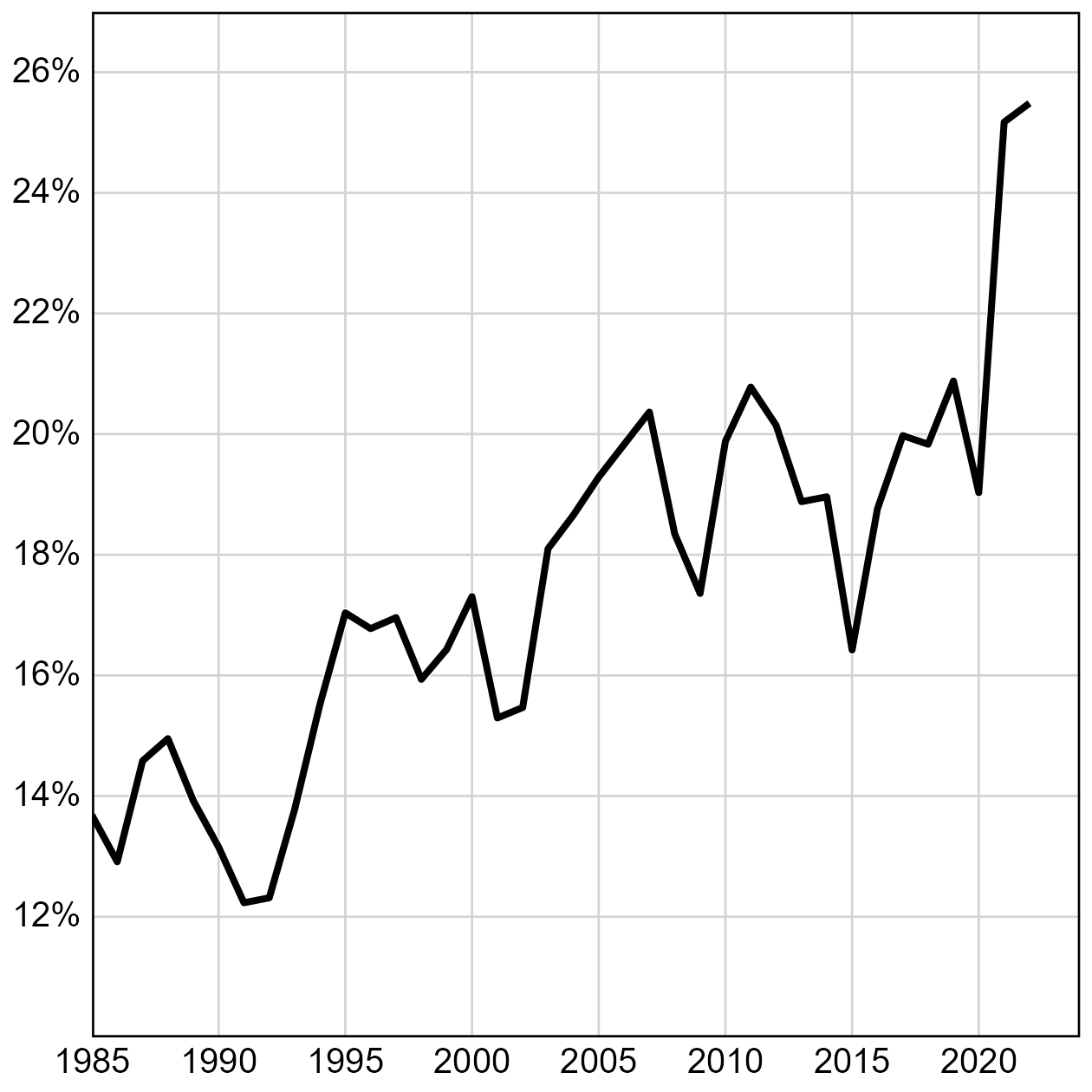
Corporate income taxes and interest are two of the unavoidable expenses that corporations must cover out of operating profits. Interest expenses fluctuate with debt levels and interest rates. Tax expenses fluctuate with tax rates and the amount of tax avoidance companies engage in.
As seen in figure 2, the share of operating profits going to interest and taxes has been trending down since the late-1980s, when these costs claimed more than 45% of operating profits. Since 2020, to cover interest and taxes required less than 29%.[2] This means more of the operating profits were left for other uses, including to fund investment.
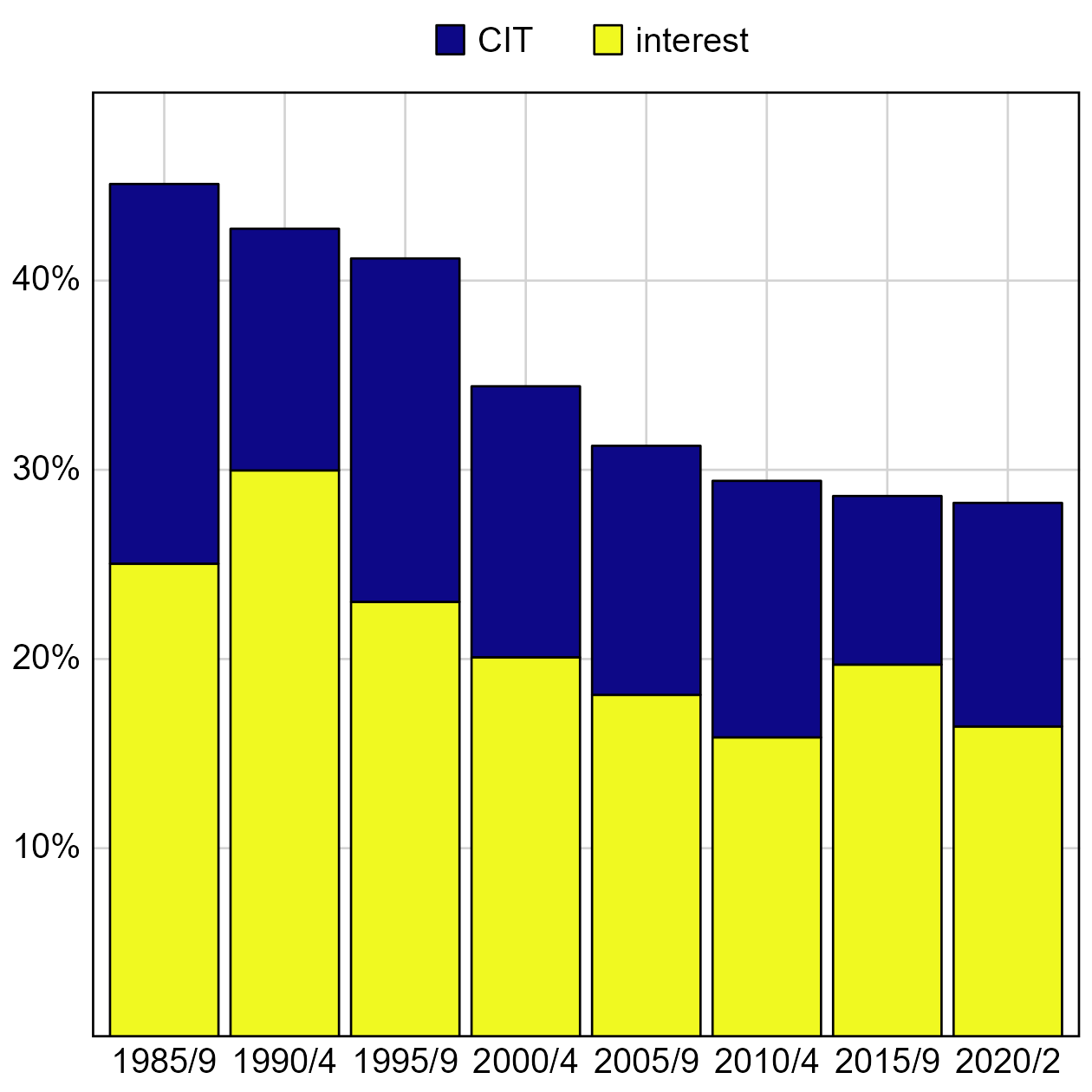
In addition to extolling corporate profits as a source of investments, Galen Weston also offered the excuse that Loblaw’s profits do not go to him personally. This is very disingenuous. The Weston family owns about 25% of Loblaw and one of the key uses of corporate profits is to fund dividends and share buybacks, which go to shareholders.
Let’s compare how much of the remaining operating profits—after interest and tax expenses—is invested and how much gets distributed to owners. For this analysis, investment is defined as expenditures on physical assets less depreciation.[3]
From 1985 to 2014, Canadian corporations distributed slightly more profit to owners than they invested—38% vs. 36% (figure 3). That changed dramatically in 2015. Over the next four years, more than 50% of profits were distributed, while less than 20% was invested. Since the pandemic, the share of profits invested has fallen to less than 10%, while shareholder distributions remained near 50%.
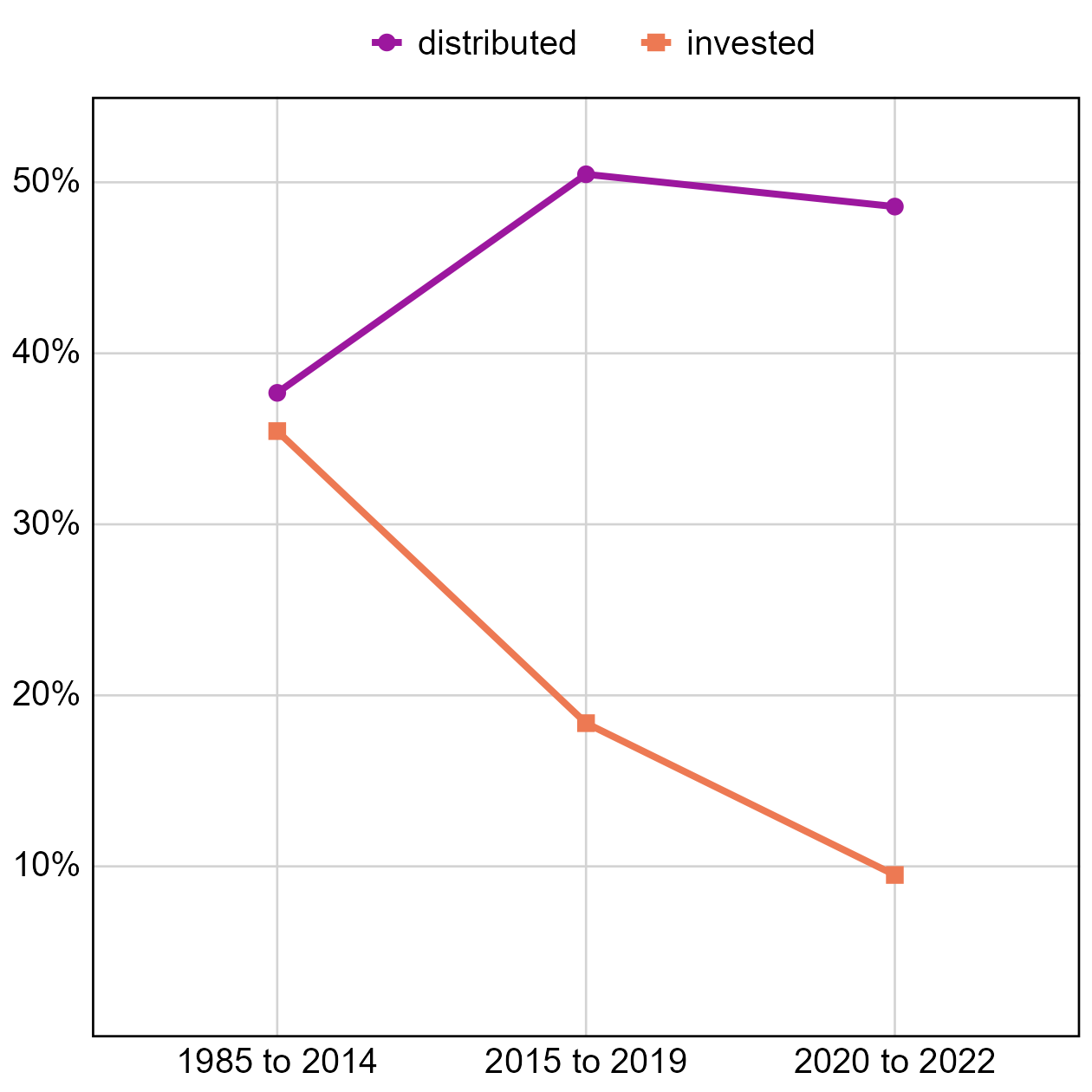
Canada’s finance sector has grown significantly over the last 40 years (figure 4).[4] In the late-1980s, the finance sector claimed 17% of all operating profits by publicly-listed Canadian-headquartered corporations. Its share reached 34% in 2007. Although the Global Financial Crisis cut its share to 23% in 2008, it quickly recovered. Since 2015, 35% of operating profits have been collected by finance.
The oil & gas sector’s share of operating profits has also grown significantly. From 13% in the late-1980s, the sector claimed more than 25% operating profits from 2000 until 2014. The collapse of oil prices in 2015 dropped the sector’s share to just 8%. However, apart from the pandemic-induced disruption of 2020, it has steadily grown, collecting 26% of operating profits in 2022.
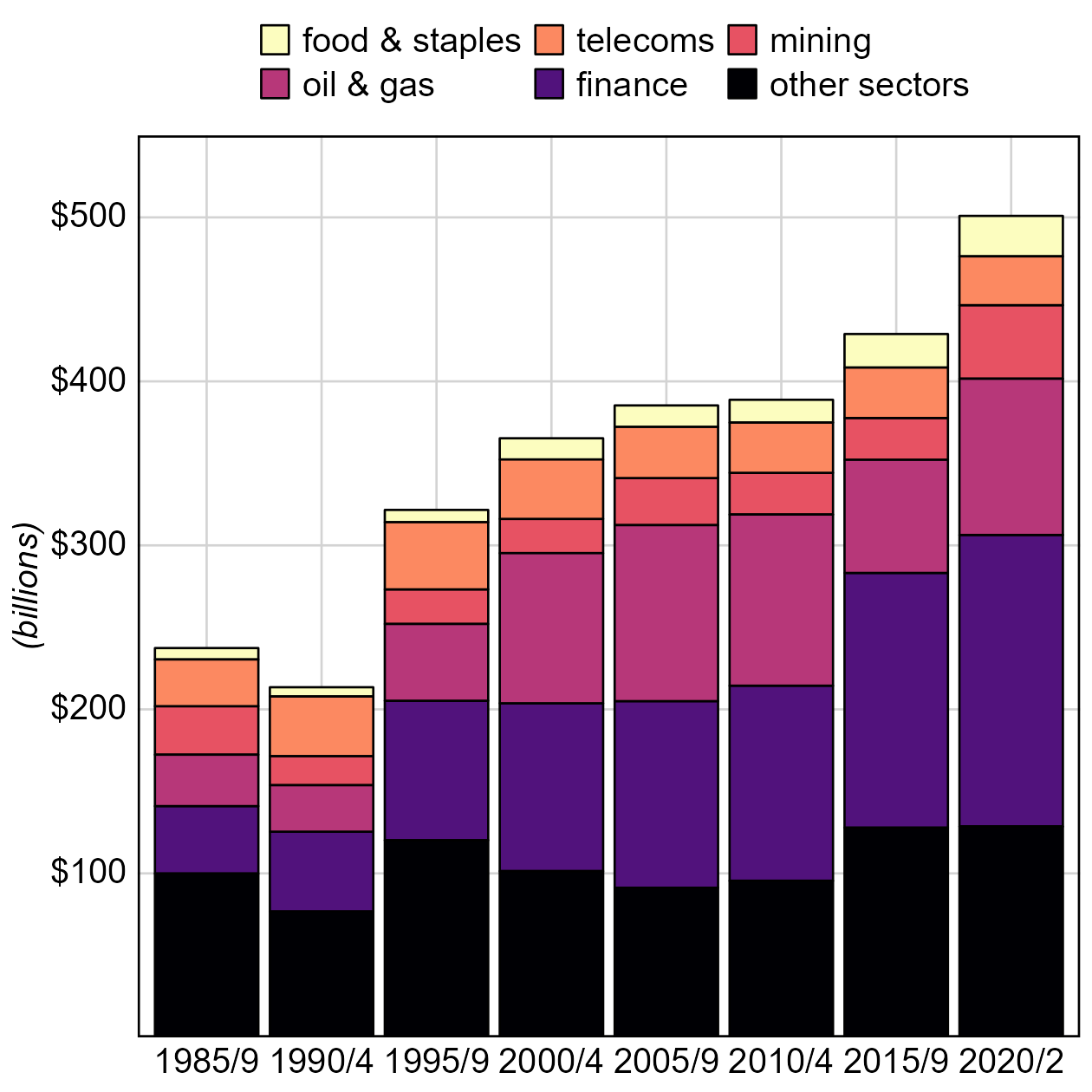
The finance and oil & gas sectors, combined, received more than half of all operating profits in 19 of the last 22 years.
Mining’s share reached an all-time high of 16% in 1988 but averaged about 7.5% until the collapse of commodity prices in the mid-2010s. It has returned to trend since the pandemic.
Telecoms have seen their share of profits steadily decline from 12% in the late-1980s to less than 6% since the pandemic. Conversely, the profit share for retailers of food & staples has steadily grown since the late-1990s.
There are important operating and accounting differences between financial and non-financial corporations. The growth of the finance sector relative to the non-finance sectors could explain some of the dramatic increase in distribution and decrease in investments. However, as figure 5 shows, most major sectors distribute more of their profit than they invest.
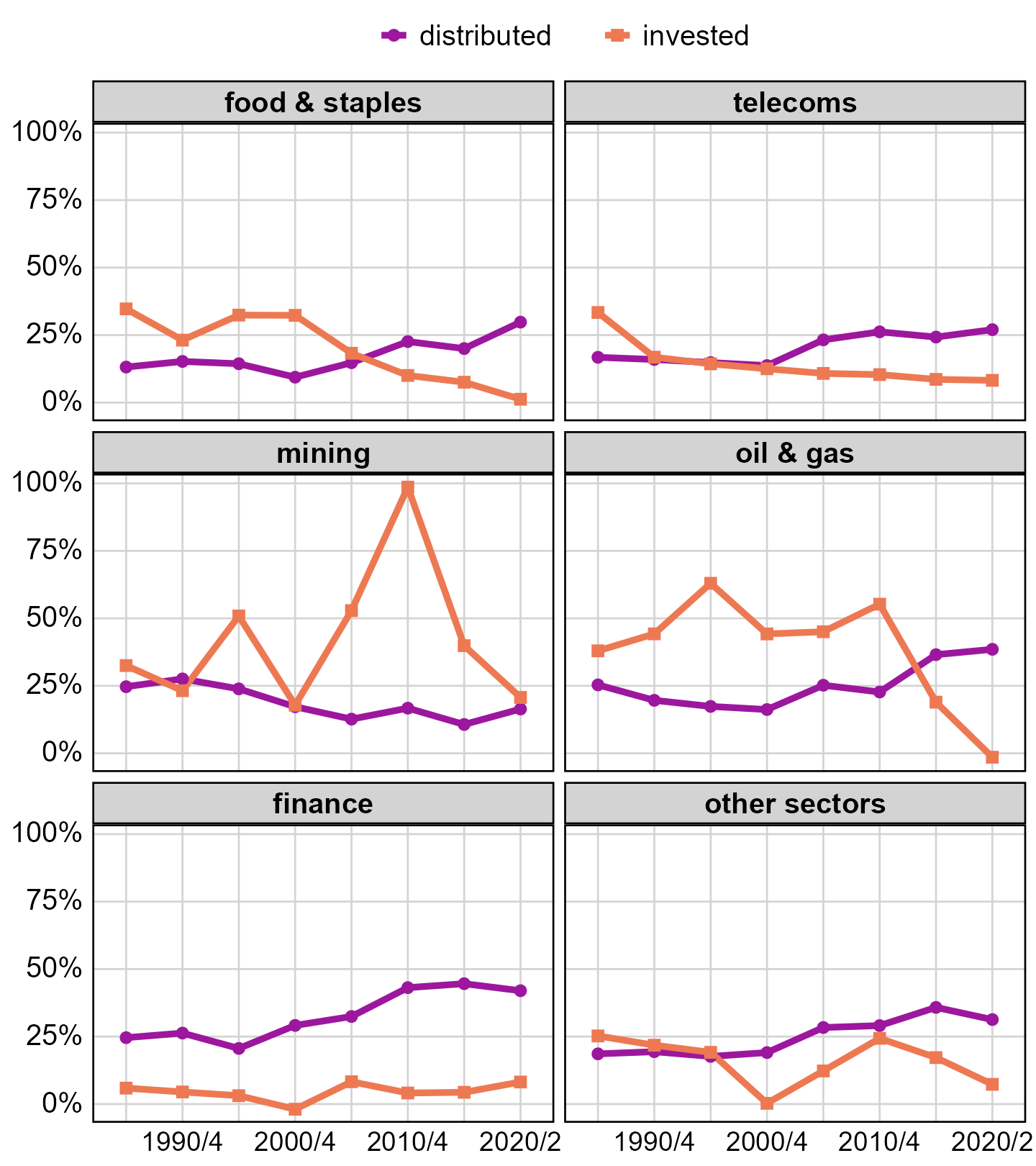
Of the sectors analyzed, only mining invests more than it distributes. Investment by food & staples retailers has trended downward since 2000 while distributions have trended upward. In 2020 to 2022, they distributed $21 billion (2022$) more than they invested. Telecoms have distributed about 25% of their profits since 2006 while their investment has fallen from a high of 33% in the late-1980s to less than 10% in almost every year since 2013.
The oil & gas sector invested much more than it distributed until 2015 when oil prices collapsed. Although oil prices and sector profits have rebounded, investment has not. In 2022, when the sector saw record profits, it distributed almost $52 billion more than it invested. Finance has consistently distributed more of its profits than it invested in productive capacity while the remaining sectors have done so since 1999.
Companies in all of Canada’s major non-finance sectors have been investing a smaller share of their profits in physical assets since at least 2015. This decline began in 2015 for the extractive industries, while it began much earlier for the other sectors. Further, in every sector, except for mining, more profit is distributed to owners than invested.
This pattern is not universal across all companies (see table below). However, it is widespread. A lack of investment in productive capacity is widely acknowledged as a major reason Canada’s productivity has stagnated. Despite decades of corporate tax cuts, which we were told would induce more investment, almost every sector invests less of their profit now than they did in the late-1980s when CIT rates were much higher.
Corporate ownership is very unequally distributed. This means distribution of a growing share of increasing profits worsens income and wealth inequality. Even if we accepted the idea that corporations are the best mechanisms for allocating capital, the data shows that instead of putting their profits into productive capacity, they are instead enriching their already rich owners.
The recent bout of pandemic-induced inflation showed that corporations have too much pricing power. Decades of policies justified as liberating the power of the market, including reduced CIT rates, have failed to produce the promised outcomes, such as more investment in productivity-enhancing assets. Rather, they seem to have made corporations more powerful social actors. Additional mechanisms beyond competitive forces need to be considered to prevent corporations from abusing that power, enriching themselves and their wealthy owners, at the expense of everyone else.
Profit is supposed to be a reward for innovation and increased efficiency. However, there is no evidence that the record profits corporations have collected since the pandemic were the result of either. Rather, they were the result of higher mark-ups in the context of rising costs. This allowed them to capture hundreds of billions of dollars from Canadian households, governments, and not-for-profits. This unearned income should be returned to public control through a windfall profit tax, so it can be invested where it is needed, such as much needed housing or improvements and expansion of the health care system. We should also end the experiment with low CIT rates.
Finally, this analysis was dependent on the financial disclosure of publicly-listed corporations. The public deserves more information about how corporations. U.S. corporations have to disclose their tax payments by jurisdiction—federal, state, foreign. Canadian corporations should be required to do the same. We should also have disclosure of country-by-country financials, so we can see were corporations are generating revenue, where they are claiming their profits, and where they are investing—or not investing.
The table below reports the share of operating profits distributed and invested by 40 of Canada’s biggest, and most high-profile non-financial corporations in the years before and since the pandemic.[5]
| Company | Use of Profit | 2000-09 | 2010-19 | 2020-22 |
|---|---|---|---|---|
| Alimentation Couche-Tard Inc | distributed | 9% | 9% | 39% |
| invested | 24% | 9% | 4% | |
| AltaGas Ltd | distributed | 3% | 50% | 45% |
| invested | 50% | 78% | 38% | |
| Barrick Gold Corp | distributed | 14% | 9% | 18% |
| invested | 19% | 35% | 5% | |
| Bausch Health Cos Inc | distributed | 36% | 5% | 1% |
| invested | -2% | 0% | 3% | |
| BCE Inc. | distributed | 21% | 29% | 37% |
| invested | 12% | 9% | 11% | |
| Bombardier Inc | distributed | 18% | 13% | 10% |
| invested | 42% | 143% | 35% | |
| Canadian National Railway Co | distributed | 35% | 46% | 53% |
| invested | 15% | 23% | 16% | |
| Canadian Natural Resources Ltd | distributed | 3% | 16% | 38% |
| invested | 46% | 13% | -19% | |
| Canadian Pacific Kansas City Ltd | distributed | 14% | 41% | 28% |
| invested | 25% | 26% | 19% | |
| Canadian Solar Inc | distributed | 0% | 0% | 0% |
| invested | 313% | 97% | 49% | |
| Canadian Tire Corp Ltd | distributed | 7% | 30% | 21% |
| invested | 30% | 8% | -2% | |
| Canfor Corp | distributed | 5% | 9% | 2% |
| invested | -9% | 8% | 2% | |
| CGI Inc | distributed | 34% | 34% | 50% |
| invested | 2% | -1% | -7% | |
| Cogeco Communications Inc | distributed | 3% | 8% | 21% |
| invested | 18% | 5% | 7% | |
| Dollarama Inc | distributed | 0% | 72% | 49% |
| invested | 5% | 6% | -11% | |
| Emera Inc | distributed | 22% | 26% | 33% |
| invested | 12% | 38% | 75% | |
| Empire Co Ltd | distributed | 5% | 13% | 19% |
| invested | 32% | 13% | -12% | |
| Enbridge Inc | distributed | 26% | 45% | 64% |
| invested | 48% | 79% | 20% | |
| Fortis Inc | distributed | 17% | 24% | 26% |
| invested | 61% | 55% | 57% | |
| Imperial Oil Ltd | distributed | 41% | 21% | 65% |
| invested | 14% | 54% | -24% | |
| Leon’s Furniture Ltd | distributed | 16% | 2% | 31% |
| invested | 19% | -6% | -22% | |
| Loblaw Cos Ltd | distributed | 12% | 29% | 35% |
| invested | 33% | 8% | 1% | |
| Lululemon Athletica Inc | distributed | 0% | 27% | 30% |
| invested | 19% | 13% | 12% | |
| Magna International Inc | distributed | 18% | 41% | 33% |
| invested | 11% | 17% | 2% | |
| Maple Leaf Foods Inc | distributed | 9% | 36% | 32% |
| invested | 9% | 35% | 79% | |
| Martinrea International Inc | distributed | 0% | 5% | 5% |
| invested | 36% | 31% | 19% | |
| Metro Inc | distributed | 18% | 43% | 33% |
| invested | 10% | 8% | 5% | |
| Nutrien Ltd | distributed | 42% | 55% | 38% |
| invested | 28% | 26% | 1% | |
| Quebecor Inc | distributed | 1% | 6% | 25% |
| invested | -2% | 9% | -10% | |
| Rogers Communications Inc | distributed | 14% | 25% | 17% |
| invested | 17% | 8% | 2% | |
| Saputo Inc | distributed | 19% | 32% | 21% |
| invested | 2% | 6% | 4% | |
| Shaw Communications Inc. | distributed | 27% | 21% | 36% |
| invested | 29% | 12% | -5% | |
| SNC-Lavalin Group Inc | distributed | 19% | 32% | 5% |
| invested | 25% | 96% | -37% | |
| Suncor Energy Inc. | distributed | 8% | 26% | 34% |
| invested | 86% | 3% | -31% | |
| TC Energy Corp | distributed | 19% | 32% | 46% |
| invested | 13% | 61% | 51% | |
| Teck Resources Ltd | distributed | 12% | 13% | 15% |
| invested | 6% | 22% | 57% | |
| TELUS Corp | distributed | 19% | 28% | 28% |
| invested | 11% | 13% | 14% | |
| Thomson Reuters Corp | distributed | 34% | 88% | 78% |
| invested | 9% | 19% | 16% | |
| Waste Connections Inc. | distributed | 19% | 14% | 27% |
| invested | 9% | -2% | 4% | |
| West Fraser Timber Co Ltd | distributed | 7% | 24% | 39% |
| invested | -26% | 15% | 1% |
This analysis uses data from the Compustat database for companies listed on North American exchanges. The database compiles data from the financial disclosures of publicly-listed companies. Reported values may be adjusted by Compustat to standardize database concepts across companies and over time.
Companies were selected using the following criteria:
Real estate companies were excluded because the sector is dominated by REITs (real estate investment trusts), which have a different tax treatment related to their distribution to owners.
Note that by focusing on Canadian-headquartered companies, this analysis is not synonymous with corporate investment in Canada. Many non-Canadian companies operate and invest in Canada, while Canadian-headquartered companies operate and invest abroad.
[1] Based on operating profits in USD adjusted for inflation by taking the value relative to US GDP.
[2] Note that this was calculated using book taxes, which are not the same as taxes actually paid. Book taxes are notional and reported on corporate income statements. Taxes paid are actual and reported on the statement of cash flow. Ostensibly, the two should only differ because of the timing difference between a company’s fiscal reporting and its tax reporting. However, companies will also defer taxes for various reasons. Taxes paid was not consistently reported until 2000.
[3] Depreciation is a notional expense. When a company makes an investment, it does not record the expense all at once. Instead, the expense gets recorded as depreciation for tangible assets, or as amortization for intangible assets. The idea is that an investment is really a kind of asset swap. The company exchanges financial assets for a productive asset. Then, the cost is the yearly wear-and-tear and/or obsolescence of that productive asset. However, for this analysis, depreciation is being treated as an actual expense, so only capital expenditure less depreciation constitutes net investment in physical assets, as a portion of capital expenditure has to be used to repair and maintain the value of existing assets.
[4] Sectors were identified using GICS codes.
[5] This calculation uses operating profits before interest and income tax expenses to eliminate incidences of a negative value in the denominator. Negative invested values occur when capital expenditures are less than depreciation, which indicates companies are not maintaining their existing physical assets.
]]>The English version is here: https://nickfalvo.ca/canadas-2024-federal-budget-whats-in-it-for-rental-housing-and-homelessness/
The French version is here: https://nickfalvo.ca/le-budget-federal-2024-quels-sont-les-avantages-our-le-logement-locatif-et-litinerance/
]]>An English summary of the new chapter can be found here: https://nickfalvo.ca/womens-homelessness/
A French summary of the new chapter is here: https://nickfalvo.ca/litinerance-chez-les-femmes/
All material related to the textbook can be found here: https://nickfalvo.ca/book/
]]>Responding to homelessness in Yellowknife: Pushing the ocean back with a spoon]]>
A ‘top 10’ summary of the chapter can be found here (in English):
https://nickfalvo.ca/homelessness-among-racialized-persons/
A ‘top 10’ summary of the chapter in French can be found here:
https://nickfalvo.ca/litinerance-chez-les-personnes-racialisees/
The full chapter can be found here (English only):
https://nickfalvo.ca/wp-content/uploads/2024/01/Falvo-Chapter-7-Racialized-Persons-2jan2024.pdf
All material related to the book is available here: https://nickfalvo.ca/book/
]]>More information is available here: https://pheedloop.com/form/view/?id=FOR596K0XGYKSXE78
]]>Here’s the link: https://cihcanada.ca/calendar-by-month/calendar-by-list/
For this particular event, there will be two components: a housing tour for 2.5 days, and then a homelessness tour for 2.5 days. We expect some people will choose to register for both, while others will pick just one.
The registration fee for each component is expected to be CA$900 + applicable taxes.
Questions pertaining to registration and logistics should be directed to Mary Clarke: mclarke@chra-achru.ca
Questions pertaining to content should be directed to me at falvo.nicholas@gmail.com
]]>A ‘top 10’ overview of the chapter can be found here: https://nickfalvo.ca/homelessness-among-indigenous-peoples/
]]>Here’s my ‘top 10’ overview of the tour: https://nickfalvo.ca/ten-things-to-know-about-homelessness-in-new-york-city/
]]>This year’s CEA conference will be held in person on June 2-3, 2023 in Winnipeg. A day of online only sessions will be held in advance of the conference on Tuesday May 30, 2023. The CEA Embrace Day with workshops will be held on Thursday June 1. As usual, PEF is hosting a number of thought-provoking sessions over the three days of the conference (see below). Many thanks to PEF’s CEA conference coordinator, Anupam Das, for putting together a stellar program.
Tuesday May 30, 2023 (ONLINE ONLY)
PEF 25th Anniversary Celebration: How has Economics Changed in the last 25 Years?
10:30am – 12:00pm
Chaired By: Jim Stanford (Centre for Future Work)
Panelists:
Marc Lavoie (U Ottawa)
Juliet Schor (Boston U)
Lars Osberg (Dalhousie U)
Jayati Ghosh (U Mass Amherst)
PEF-CDHI Panel: Modern Monetary Theory in This Period of Post-pandemic Inflation: Time to Praise or Time to Bury
12:15pm – 1:45pm
Chaired By: David Pringle (Independent)
Panelists:
Brian Romanchuk (Independent)
Eric Tymoigne (Lewis and Clark College)
Mark Zelmer (Independent)
Christopher Regan (McGill U)
PEF Panel: Is a Pro-Labour Competition Policy Possible?
2:00pm – 3:30pm
Chaired By: Robin Shaban (Carleton University, Canadian Anti-Monopoly Project)
Panelists:
Kaylie Tiessen (Unifor)
Matthew Chiasson (Competition Bureau Canada)
Robin Shaban (Carleton University, Canadian Anti-Monopoly Project)
PEF: Teaching Heterodox Economics
2:00pm – 3:30pm
Chaired By: Jesse Hajer
Presenters:
Sonya Scott (York U), “How to Teach Against the World? Strategies for introducing heterodox economics into the undergraduate classroom”
Vicki Zhang (U Toronto), “Towards a New Pedagogy for Finance: Myths and Alternatives”
Salewa Olawoye (York U), “Mainstream Economics: The dangerous (intentional?) omission of exclusion and inequality”
Discussants:
Salewa Olawoye (York U)
Sonya Scott (York U)
Vicki Zhang (U Toronto)
Friday June 2, 2023
PEF Panel: Development Pluralisms: Then & Now
8:30am – 10:00am
Chaired By: Anupam Das (Mount Royal U)
Panelists:
John Serieux (U Manitoba)
Jonathan Jenner (U Manitoba)
Albert Berry (U Toronto)
PEF 25th Anniversary Celebration Event: 1919 Strike Tour! (see details below regarding sign up)
Winnipeg Downtown 1919 Strike Tour (PEF 25th Anniversary Event)
10:30am – 12:00pm, Friday, 2 June 2023
Space is limited and will be based on a first come first serve basis. Please email to confirm attendance to Anupam Das, adas@mtroyal.ca
PEF: Galbraith Prize in Economics
Walking With Giants: What Galbraith Can Teach Us About This Moment in Economic Thought
Presenter: Armine Yalnizyan
2:00pm – 3:30pm
PEF Panel: Economic Thought
4:00pm – 5:30pm
Chaired By: Fletcher Baragar (U Manitoba)
Panelists:
Bill Gerrard (U Leeds)
Robert Chernomas (U Manitoba)
Anna Klimina (U Saskatchewan)
Saturday June 3, 2023
CSLS-PEF Panel Session: Inflationary Shocks, Real Wages, and Income Distribution in Canada since 2019: Are We Witnessing a Wage-Price Spiral?
8:30am – 10:00am
Chaired By: Andrew Sharpe (Centre for the Study of Living Standards)
Panelists:
Mario Seccareccia (U Ottawa)
Danny Leung (Statistics Canada)
Tim Sargent (Centre for the Study of Living Standards)
Angella MacEwan (CUPE)
PEF Panel: John Loxley and Progressive Economics
10:30am – 12:00pm
Chaired By: Robert Chernomas (U Manitoba)
Panelists:
Jim Stanford (Centre for Future Work)
Raina Loxley (Pollock’s Hardware Co-op)
Shauna Mackinnon (U Winnipeg) and Lynne Fernandez (Canadian Centre for Policy Alternatives)
PEF Annual General Meeting
2:00pm – 3:30pm, Saturday
The full CEA programme information, including presenter bios and brief descriptions of each PEF session can be found here.
]]>The latest chapter, on health, is now available.
A ‘top 10’ overview of the chapter can be found here:
https://nickfalvo.ca/health-and-homelessness/
All information pertaining to the book can be found here:
https://nickfalvo.ca/book/